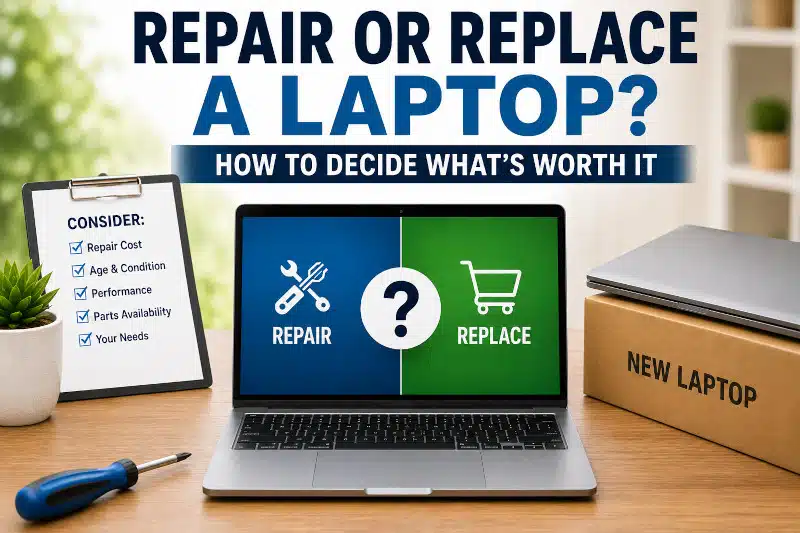
Should you repair or replace a laptop when something goes wrong? The answer depends on much more than the computer’s age. Repair cost, overall condition, performance, replacement-part availability, and whether the laptop still meets your needs all play a role.
A laptop that won’t start, runs slowly, overheats, or won’t charge may seem ready for replacement. However, the underlying problem could be relatively straightforward to repair. On the other hand, spending a significant amount of money on a computer with several problems or outdated hardware may not make financial sense.
Before buying another computer, determine what’s actually wrong with your current laptop. A proper diagnosis can help you compare the cost and benefits of repairing the computer against replacing it.
Repair or Replace a Laptop? Start With the Actual Problem
The first step is identifying the cause of the problem.
For example, a laptop that won’t turn on could have a charging problem, battery issue, power-related failure, or another hardware problem. Similarly, a slow laptop might have software problems, insufficient memory, storage issues, excessive background activity, or aging hardware.
Without knowing the cause, it’s difficult to determine whether repairing or replacing the laptop makes sense.
That’s why I recommend diagnosing the computer before assuming that it has reached the end of its useful life.
Some problems may require only one repair. Others may reveal multiple issues that change the economics of keeping the computer.
Consider the Cost of Laptop Repair
Repair cost is one of the most important factors when deciding whether to repair or replace a laptop.
However, simply comparing the repair estimate with the price of the cheapest new laptop doesn’t provide a fair comparison.
Instead, consider:
- Cost of the proposed repair
- Current condition of the laptop
- Specifications and performance
- Cost of a comparable replacement
- Availability of replacement parts
- Likely useful life after the repair
- Whether other components are beginning to fail
Suppose your current laptop meets your needs and requires one reasonably priced repair. Keeping it may make considerably more sense than replacing it.
However, if the laptop has several hardware problems and needs an expensive repair, putting that money toward another computer may offer better value.
The decision depends on the complete situation rather than a single repair-cost percentage.
Don’t Judge Whether a Laptop Is Worth Repairing by Age Alone
Laptop age matters, but I don’t recommend using a rigid age cutoff.
You may hear advice that a laptop automatically becomes unrepairable after four or five years. Real-world repair decisions aren’t that simple.
An older, well-built laptop with adequate performance may still be worth repairing if it needs a reasonably priced battery, keyboard, storage drive, or another serviceable component.
Meanwhile, a much newer entry-level laptop could have extensive physical or motherboard damage, making an expensive repair difficult to justify.
Instead of looking only at age, consider:
- Original quality of the laptop
- Processor and overall specifications
- Amount of memory
- Storage configuration
- Physical condition
- Operating-system compatibility
- Parts availability
- Current performance
- Your actual computing requirements
Age should influence the decision, but it shouldn’t make the decision for you.
When Laptop Repair Often Makes Sense
Repairing your existing laptop often makes sense when it remains in good overall condition and still performs the tasks you need it to.
Examples may include problems involving:
Laptop Battery Replacement
A worn battery doesn’t automatically mean you need another laptop.
Lithium-ion batteries deteriorate over time. If the computer still performs well and a compatible replacement battery is available, replacing the battery may extend the laptop’s useful life.
Laptop Keyboard Problems
A malfunctioning keyboard may be repairable without replacing the entire computer.
However, laptop designs vary. Some models use a separate, replaceable keyboard, while others integrate the keyboard into the palm rest or top cover assembly.
Therefore, the exact repair and cost depend on the model.
Compatible Charging Port Problems
Some laptops use a replaceable charging-port harness or cable assembly.
When that type of charging port fails, and the appropriate part is available, replacement may make sense.
I don’t replace charging ports that require soldering directly to the motherboard.
Storage Drive Problems
A storage problem doesn’t automatically mean the laptop needs replacement.
Depending on the computer, replacing an older or problematic drive with a solid-state drive may restore reliable operation and improve responsiveness.
The rest of the laptop’s condition still matters, particularly if the storage device has actually failed.
RAM and Storage Upgrades
Some laptops allow memory or storage upgrades that can improve performance or provide additional capacity.
However, many newer laptops use soldered memory or other integrated components. Therefore, upgrade options vary by manufacturer and model.
Windows and Software Problems
Operating-system corruption, malware, driver problems, excessive startup software, and other software issues can make an otherwise functional laptop appear much worse than it really is.
Resolving the software problem may restore normal operation without replacing the computer.
Cooling and Fan Problems
Excessive heat, restricted airflow, or a failing cooling fan can affect performance and stability.
If the rest of the laptop is in good condition, fixing the cooling problem may make more sense than replacing the entire computer.
When Replacing a Laptop May Make More Sense
Sometimes replacement is the more practical choice.
The important distinction is that no single factor automatically determines the answer.
Replacement deserves serious consideration when several disadvantages occur together.
The Laptop Has Multiple Hardware Problems
One repair may be reasonable.
Several expensive repairs on the same aging computer can change the equation considerably.
For example, if a laptop needs a battery, a keyboard, replacement of damaged case components, and another significant hardware repair, the combined expense may approach the cost of a suitable replacement.
The Repair Cost Is Too High for the Laptop’s Value
Some repairs become difficult to justify economically.
An expensive motherboard-related failure on an older or inexpensive laptop is a good example.
The computer may technically be repairable, but technical repairability and financial practicality aren’t always the same thing.
Replacement Parts Are Unavailable
Laptop manufacturers use many model-specific components.
As computers age, certain batteries, keyboards, fans, charging assemblies, and other parts may become difficult to obtain.
If I can’t obtain a reliable compatible part, replacing the computer may become the more practical option.
The Laptop No Longer Meets Your Needs
A successful repair won’t change the laptop’s fundamental capabilities.
If you now need considerably more performance for gaming, content creation, engineering software, large datasets, or another demanding workload, repairing an underpowered computer may not solve the real problem.
In that situation, investing in a more capable system can make more sense.
The Laptop Has Extensive Physical Damage
A damaged hinge alone may not tell the entire story.
A severe drop or impact can damage the case, display assembly, hinges, internal mounting points, motherboard, or several components at once.
Extensive damage can make repair impractical even when individual replacement parts exist.
Repair or Replace a Laptop Based on Your Actual Needs
Your computing needs should play a major role in the decision.
Not everyone needs the latest processor, large amounts of memory, a dedicated graphics card, or premium features.
If you primarily use your laptop for:
- Web browsing
- Microsoft Office
- Online banking
- Video streaming
- Video calls
- Basic photo management
- Everyday household tasks
An older laptop that still performs those jobs reliably may continue to serve you well after a reasonable repair.
Conversely, your needs may have changed since you purchased the computer.
Perhaps you now use demanding professional software, edit video, play modern games, or need much longer battery life away from an outlet.
In that situation, replacement may provide benefits that repairing the existing laptop can’t deliver.
The better question isn’t simply, “How old is my laptop?”
Ask:
“After this repair, will this laptop still do what I need it to do?”
Can a Laptop Upgrade Make More Sense Than Replacement?
Sometimes the best answer isn’t simply repair or replacement.
An upgrade may extend the useful life of a laptop that remains in good condition.
For compatible laptops, possible upgrades may include additional RAM or a larger/faster solid-state drive.
An SSD can make a significant difference when replacing an older mechanical hard drive. Additional RAM may also help a computer that regularly runs short on available memory.
However, not every laptop supports these upgrades.
Manufacturers increasingly solder memory directly to the motherboard, and some computers provide limited internal expansion options.
Before purchasing upgrade components, confirm what the specific laptop supports.
My Computer Hardware Upgrades in Davenport, FL service can help determine whether a compatible RAM or storage upgrade makes sense for your computer.
Does a Bad Laptop Battery Mean You Need a New Laptop?
Usually, battery condition should be considered separately from the condition of the entire computer.
Rechargeable laptop batteries are consumable components. They gradually lose capacity over time, with use and charge cycles.
Therefore, poor battery runtime alone doesn’t necessarily justify replacing an otherwise useful laptop.
If the computer performs well and a compatible replacement battery is available, replacing the battery may be the more economical option.
However, consider the laptop’s overall condition before investing in a battery for an older system.
If the computer also has performance problems, physical damage, keyboard issues, or other failures, those additional factors may influence the decision.
What About a Swollen Laptop Battery?
A swollen battery requires more immediate attention than ordinary battery wear.
If the touchpad is lifting, the bottom case is bulging, case panels are separating, or the battery has visibly expanded, stop using and charging the laptop.
Don’t puncture, bend, squeeze, or attempt to flatten an expanded lithium-ion battery.
My guide to Swollen Laptop Battery: Warning Signs, Causes, and What to Do explains the warning signs, possible causes, and appropriate next steps.
Battery swelling doesn’t automatically mean the entire laptop needs replacement. However, the expansion may place pressure on the touchpad, keyboard, case, or other components.
The amount of resulting physical damage should factor into the repair-versus-replacement decision.
Compare Laptop Repair With a Comparable Replacement
When deciding whether to repair or replace a laptop, compare like with like.
Suppose a repair costs $200.
Finding a new laptop advertised for $300 doesn’t automatically mean replacement provides better value.
Does the $300 computer offer the same or better:
- Processor performance?
- Memory capacity?
- Storage capacity?
- Display quality?
- Build quality?
- Connectivity?
- Features you actually use?
If replacing your existing computer with a comparable model would cost substantially more than the repair, repairing it may still represent good value.
On the other hand, if an appropriate replacement costs only moderately more than a major repair and provides meaningful improvements, replacement becomes more attractive.
Compare the repair with the computer you would realistically purchase—not simply the least expensive laptop you can find.
Consider the Laptop’s Overall Condition
Look beyond the immediate failure.
A laptop in excellent physical condition with one failed component presents a very different situation from a computer with numerous developing problems.
Consider the condition of:
- Battery
- Keyboard
- Touchpad
- Hinges
- Charging system
- Cooling system
- Storage
- Case
- Display
- USB and other ports
You don’t need every component to be perfect.
However, multiple deteriorating parts may indicate that additional repair expenses could arise in the future.
That’s especially important when evaluating a costly repair.
What About Your Files When Replacing a Laptop?
Your files deserve consideration before you replace the computer.
Documents, photographs, downloads, browser data, financial records, and other information may still reside on the old laptop.
If the storage drive remains readable, those files may be transferable to another computer.
My Data Backup & File Transfer in Davenport, FL service can help move accessible files from an old computer to a replacement system.
I don’t provide advanced data recovery from physically failed or unreadable storage drives, and I don’t recover deleted files.
Therefore, regularly backing up important data remains important whether you repair or replace the laptop.
Repairing vs. Replacing a Laptop: A Simple Checklist
Still unsure whether to repair or replace a laptop? Consider the following factors together.
Repair May Make Sense When:
- The laptop still meets your computing needs.
- The repair cost is reasonable.
- The computer has one primary problem.
- The rest of the laptop remains in good condition.
- Reliable replacement parts are available.
- A repair or upgrade could provide several more years of use.
- A comparable replacement would cost significantly more.
Replacement May Make Sense When:
- The laptop has several expensive problems.
- Repair costs are high relative to the cost of a suitable replacement.
- Important replacement parts are unavailable.
- The laptop no longer provides enough performance.
- The computer has extensive physical damage.
- Several components are deteriorating simultaneously.
- The system no longer supports the software or operating environment you need.
No universal age or repair-cost percentage works for every laptop.
The right decision depends on the computer, the problem, the repair cost, and what you need from the system.
Not sure whether your laptop is worth repairing? Contact PCMechanic Computer Repair in Davenport, FL for professional diagnostics and help deciding whether repair or replacement makes more sense.

Not Sure Whether to Repair or Replace Your Laptop?
Sometimes the answer isn’t obvious until someone diagnoses the actual problem.
A computer that appears completely unusable may have a repairable issue. Meanwhile, a laptop that needs an expensive repair may have additional problems that make replacement more sensible.
I can diagnose the laptop, explain what I find, and discuss the available repair options.
If repairing the computer doesn’t make financial sense, I’ll tell you.
Is Your Laptop Beyond Repair?
A laptop that won’t start, repeatedly crashes, overheats, or has a failed component isn’t necessarily beyond repair. Many serious-looking problems can still have practical solutions once the actual cause is identified.
However, replacement may make more sense when the laptop has multiple hardware problems, extensive physical damage, unavailable replacement parts, inadequate specifications, or a repair cost that’s difficult to justify. The overall condition of the computer matters more than any single symptom.
Before assuming a laptop is beyond repair, diagnosis can determine what’s actually wrong and whether fixing it remains practical.
Are Laptops Worth Repairing?
Laptops can be worth repairing when the repair cost is reasonable, the computer still meets your needs, replacement parts are available, and the rest of the laptop remains in good condition. A battery, keyboard, cooling fan, storage drive, or other practical repair may extend the computer’s useful life without requiring you to replace the entire laptop.
However, replacement may make more sense when the laptop has outdated hardware, multiple problems, limited upgradeability, unavailable replacement parts, or a repair cost that’s difficult to justify. The decision should consider the laptop’s overall condition and how well it still meets your computing needs.
Consider the Environmental Impact
Repairing a laptop that still meets your needs can also help reduce electronic waste by keeping otherwise usable hardware in service longer. If the computer remains capable, a reasonable repair or upgrade may allow you to continue using it rather than replacing an otherwise functional device.
However, environmental considerations shouldn’t automatically justify an expensive repair on a laptop that no longer meets your needs. Cost, reliability, specifications, parts availability, and expected remaining life should still factor into the decision.
Why Choose PCMechanic for Laptop Repair in Davenport, FL?
I have provided computer repair services in Davenport, Florida, since 2012.
When you bring me a laptop, you work directly with the technician who diagnoses and repairs the computer. I can evaluate the problem, determine which repair options are practical, and help you understand whether investing additional money in the laptop makes sense.
My Laptop Repair in Davenport, FL service covers many common hardware, Windows, software, battery, keyboard, cooling, charging, and performance problems.
PCMechanic Computer Repair is a home-based repair business. Customers arrange to drop off and pick up their computers directly with me.
Many repairs can move quickly when they don’t require replacement parts. When parts are necessary, turnaround depends on availability and shipping time.
Frequently Asked Questions About Repairing or Replacing a Laptop
Is it cheaper to repair or replace a laptop?
It depends on the problem. A reasonably priced laptop repair that still meets your needs can cost much less than purchasing a comparable replacement. However, replacement may make more sense when repair costs become high, or the laptop has several problems.
How old is too old to repair a laptop?
There isn’t a universal age cutoff. Consider performance, overall condition, operating-system compatibility, parts availability, repair cost, and whether the laptop still meets your needs.
Is a five-year-old laptop worth repairing?
It can be. A five-year-old laptop in good condition may remain perfectly useful after a reasonable repair. Age alone shouldn’t determine whether you keep or replace it.
Is it worth replacing a laptop battery?
Often, yes. If the laptop still performs well and a compatible battery is available, replacing a worn battery can make more sense than replacing the entire computer.
Is it worth repairing a laptop motherboard?
That depends heavily on the laptop’s value, age, specifications, the type of motherboard issue, the cost of the replacement part, and the labor involved. On some laptops, replacing the motherboard makes sense. For others, replacing the computer may provide better value.
Should I repair a slow laptop or buy a new one?
First, determine why the laptop is slow. Software problems, limited memory, storage issues, or excessive background activity may be correctable. However, replacement may make more sense if the computer’s underlying hardware no longer provides enough performance for your needs.
Can upgrading RAM or an SSD extend a laptop’s life?
Yes, on compatible laptops. Additional memory or an SSD can improve the usefulness of some computers. However, upgradeability varies considerably because many newer laptops use soldered or integrated components.
What should I do with my files if I replace my laptop?
Back up or transfer important files before retiring the old computer, as long as the storage remains readable. Documents, photographs, and other accessible data can often move to the replacement computer.
How do I know when a laptop is beyond repair?
A laptop may be technically repairable but economically impractical to fix. Extensive physical damage, multiple hardware failures, unavailable parts, high repair costs, or hardware that no longer meets your needs can all make replacement a more sensible option.
Can you tell me whether my laptop is worth repairing?
Yes. Diagnosing the actual problem and estimating what the laptop needs can provide the information necessary to make a practical repair-versus-replacement decision.
Get Help Deciding Whether to Repair or Replace Your Laptop
If your laptop isn’t working properly and you’re unsure whether to repair or replace it, don’t assume you need another computer until you identify the problem.
I can diagnose the laptop, explain the repair options, and help you determine whether putting additional money into the computer makes sense.
If the repair is practical, I can discuss the next steps. If replacement makes more sense based on the computer’s condition and repair needs, I’ll explain why.
Contact PCMechanic Computer Repair in Davenport, FL today for professional laptop diagnostics and repair service.