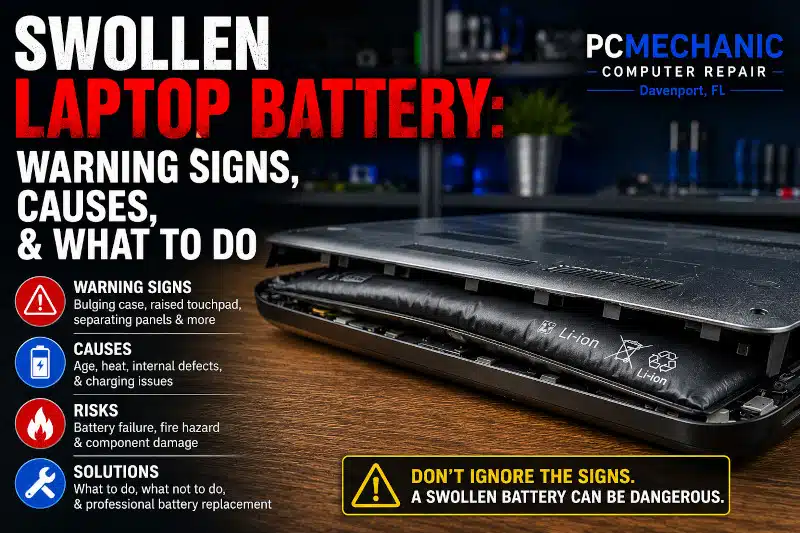
A swollen laptop battery should be taken seriously. Lithium-ion batteries can swell when internal chemical reactions produce gas inside deteriorating battery cells. As the battery expands, it can place pressure on the laptop case, touchpad, keyboard, and other internal components.
If you suspect that your laptop battery is swollen, stop using and charging the laptop until a technician evaluates the battery. Don’t puncture, bend, squeeze, or attempt to flatten a swollen battery.
Recognizing the warning signs early can help prevent further physical damage to the laptop and reduce the risks of continued use of a deteriorated battery.
Signs of a Swollen Laptop Battery
You don’t always need to see the battery itself to recognize possible swelling.
Many modern laptops use internal batteries hidden beneath the bottom cover. Therefore, the first warning signs often appear as physical changes to the laptop’s case.
Common signs include:
- Bottom case beginning to bulge
- Gaps appearing between case panels
- Touchpad lifting above the palm rest
- Touchpad becoming difficult to click
- Keyboard or palm rest beginning to rise
- Laptop wobbling on a flat surface
- Bottom cover no longer sitting flush
- Visible battery expansion if the laptop is already open
Any unexpected change in the laptop’s shape deserves attention.
Don’t force separated case panels back together. Pressure from an expanding battery may be causing the case to separate.
Raised or Difficult-to-Click Touchpad
A raised touchpad is one of the more recognizable signs of a swollen laptop battery.
On many laptops, the battery sits underneath or near the touchpad and palm-rest assembly. As the battery expands, it can push upward against those components.
You may notice that the touchpad no longer sits flush with the surrounding case.
It may also become difficult to click, feel unusually stiff, or appear higher on one side.
A swollen battery does not automatically indicate a touchpad problem. Touchpads can develop their own mechanical or electrical problems.
However, consider a raised touchpad combined with case separation or bulging a possible battery issue.
Bottom Case Separation or Bulging
Battery expansion can also push against the laptop’s bottom cover.
You may notice a gap forming between the bottom panel and the upper chassis. Screws may appear unable to hold the case completely closed, or one section of the bottom cover may begin protruding outward.
The laptop may also stop sitting evenly on a desk or other flat surface.
Don’t tighten screws or press the case together to correct the gap.
If an expanding battery is responsible, applying additional pressure isn’t an appropriate solution.
Keyboard or Palm Rest Lifting
Depending on the battery’s location inside the laptop, swelling can place pressure on the keyboard deck or palm rest.
The keyboard area may begin to curve upward, or the palm rest may no longer appear level.
Again, these physical changes don’t prove that the battery is responsible. However, they warrant inspection, particularly when several symptoms appear together.
What Causes a Swollen Laptop Battery?
Under normal operating conditions, laptop batteries maintain their original shape.
Swelling indicates that something has changed inside the battery cells. Several factors can contribute to that deterioration.
Battery Age and Chemical Degradation
Lithium-ion batteries gradually deteriorate over time.
Every charge-discharge cycle contributes to chemical aging. Batteries can degrade as they get older, even when they aren’t heavily used.
As a battery deteriorates, unwanted chemical reactions can occur inside its cells. In some cases, those reactions generate gas.
Because the battery cell seals in the gas, the accumulating pressure causes the battery pouch to expand.
This expansion creates the swollen appearance.
Excessive Heat
Heat can accelerate lithium-ion battery degradation.
Laptop batteries already operate in relatively compact spaces near heat-generating components. High environmental temperatures or persistent internal heat can place additional stress on the battery over time.
However, a warm laptop doesn’t necessarily develop a swollen battery.
Over time, prolonged exposure to excessive temperatures can accelerate battery deterioration.
If your laptop is also overheating, the cooling system may need separate attention.
Battery Cell or Manufacturing Defects
Occasionally, a battery may develop an internal problem earlier than expected.
A defect involving a cell, separator, manufacturing process, or another internal component can contribute to premature deterioration.
Although many swollen batteries are older, battery age alone doesn’t determine whether swelling can occur.
You should take a relatively new battery that is physically expanding seriously.
Physical Damage
Physical damage can compromise a lithium-ion battery.
Impact, crushing, puncturing, bending, or other mechanical damage can affect the battery’s internal structure.
For this reason, a swollen battery shouldn’t be manipulated in an attempt to restore its original shape.
A battery that has physically expanded isn’t repairable by pressing it flat.
Charging or Battery-Management Problems
Modern laptops use charging and battery-management circuitry to regulate battery operation.
Therefore, leaving a modern laptop connected to its charger doesn’t mean the battery continues charging indefinitely after it reaches full charge.
However, abnormal charging conditions, battery-management problems, a defective battery, or other electrical issues can contribute to battery deterioration.
The condition of the complete charging system may need to be considered when battery problems occur unexpectedly.
Why Does a Laptop Battery Swell?
A swollen laptop battery expands because gas has accumulated inside one or more battery cells.
Lithium-ion batteries depend on controlled chemical reactions to store and release energy.
As the battery ages or deteriorates, unwanted reactions can occur within the cells. These reactions may produce gases that remain trapped inside the sealed battery pouch.
The battery then begins expanding.
Once physical swelling occurs, consider the battery unhealthy and don’t return it to normal service.
Swelling can’t be corrected by recalibrating the battery, changing Windows settings, or repeatedly charging and discharging it.
The deteriorated battery needs to be addressed.
Is a Swollen Laptop Battery Dangerous?
A swollen battery indicates internal deterioration and shouldn’t be ignored.
The expansion itself can place pressure on the laptop’s internal components and chassis. Continued charging, physical pressure, puncturing, bending, or other damage can increase the risk of further battery failure.
Lithium-ion battery failures can, under some circumstances, lead to a thermal event or fire.
That doesn’t mean every swollen battery will suddenly catch fire. However, swelling is a clear sign that the battery is no longer operating in its normal physical condition.
Instead, stop using and charging the affected laptop and arrange for a professional evaluation.
What Should You Do With a Swollen Laptop Battery?
If you suspect battery swelling, stop using the laptop.
Disconnect the external power adapter and avoid charging the battery again.
Don’t continue operating the computer simply because it still turns on normally.
A laptop may continue functioning even though the battery has physically deteriorated.
If the case is separating, the touchpad is lifting, or another part of the chassis appears distorted, don’t press the components back into position.
Arrange for the battery and laptop to be evaluated.
If you can obtain a compatible replacement battery and the laptop is otherwise in good condition, a new battery may allow the computer to continue providing useful service.
What Not to Do With a Swollen Laptop Battery
A swollen laptop battery requires careful handling.
Avoid actions that can place additional physical or electrical stress on the battery.
Don’t Continue Charging It
Once you suspect a battery has swollen, don’t continue using the laptop with its charger for normal use.
Charging a visibly deteriorated battery isn’t recommended.
Don’t Puncture the Battery
Never intentionally puncture a lithium-ion battery.
Don’t use a screwdriver, knife, drill, or other sharp object to release the swelling.
The gas shouldn’t be released manually.
Don’t Bend, Squeeze, or Flatten It
Restoring a swollen battery to its original shape won’t repair it.
Don’t squeeze it, bend it, stand on it, place weight on it, or attempt to flatten the battery.
Don’t Force the Laptop Case Closed
If battery expansion has caused the bottom cover, palm rest, keyboard, or touchpad to lift, don’t force the laptop back together.
The expanding battery may be creating the pressure.
Don’t Put It in Household Trash
Lithium-ion batteries shouldn’t be discarded with ordinary household garbage.
A damaged or swollen battery requires proper handling and disposal through a facility or collection program that accepts such batteries.
Concerned about a swollen laptop battery or a case that is beginning to separate? Contact PCMechanic Computer Repair in Davenport, FL for professional battery evaluation and replacement.

Swollen Laptop Battery Replacement
You cannot reverse battery swelling.
Once a lithium-ion laptop battery physically swells, replacement generally makes sense if you can obtain a compatible battery and the laptop is still worth repairing.
My Laptop Battery Replacement Service in Davenport, FL can help when a deteriorated or swollen battery needs replacement.
Before replacing the battery, I also inspect the laptop for physical effects caused by the expansion.
Depending on the severity and location of the swelling, pressure from the battery may affect the:
- Bottom cover
- Touchpad
- Palm rest
- Keyboard assembly
- Internal mounting points
- Other nearby components
Replacing the battery removes the deteriorated component, but any additional physical damage should also be considered.
Parts availability depends on the laptop manufacturer and exact model.
Can a Swollen Battery Damage the Laptop?
Yes, physical expansion can damage or distort parts of the laptop.
The battery occupies a fixed amount of space inside the chassis. As it expands, that additional volume has to push somewhere.
Depending on the laptop’s internal layout, pressure can affect the bottom cover, touchpad, keyboard, palm rest, or internal mounting points.
Severe swelling may cause case panels to separate significantly.
If the swelling has distorted the case, touchpad, keyboard, or another component, additional Laptop Repair in Davenport, FL may be necessary after the battery issue is addressed.
This is another reason not to force the laptop case back together.
Can a Swollen Laptop Battery Be Repaired?
No.
Battery swelling indicates physical and chemical deterioration inside the cells.
Software updates, battery calibration, charging cycles, or other adjustments can’t reverse that condition.
Likewise, the battery shouldn’t be opened or compressed to remove the swelling.
When the battery has physically expanded, replacement and proper disposal are the appropriate course of action.
How Should a Swollen Laptop Battery Be Disposed Of?
Don’t place a swollen lithium-ion battery in household trash or standard recycling.
Dispose of damaged lithium-ion batteries properly because they require different handling from ordinary household waste.
Some battery-recycling programs, electronics recycling facilities, and local hazardous-material collection programs accept damaged or swollen lithium-ion batteries.
However, acceptance policies vary.
Before transporting a swollen battery, contact the intended facility and confirm that it accepts damaged or swollen lithium-ion batteries and ask about its handling and transportation requirements.
Don’t assume that every retail battery-recycling drop-off location accepts damaged batteries.
Can You Prevent Laptop Battery Swelling?
No method can guarantee that a lithium-ion battery will never swell. Batteries are consumable components that chemically age over time.
However, avoiding unnecessary heat and using the laptop under reasonable operating conditions can help support battery longevity.
Don’t assume that a battery must remain at 100% charge at all times to stay healthy.
Many modern laptops also include manufacturer-specific battery-health or charge-management features designed for systems that spend long periods connected to external power.
For broader information about charging habits, heat, storage, and maintaining battery health, see Laptop Battery Care: Maximizing Lifespan and Performance.
Even with proper care, aging batteries can still swell.
When Should You Replace a Swollen Laptop Battery?
Stop using a battery as soon as you notice visible swelling.
If the laptop still works properly and you can obtain a compatible battery, replacing the battery may be worthwhile.
Factors to consider include:
- Laptop age
- Overall condition
- Replacement battery availability
- Cost of the battery
- Physical damage caused by swelling
- Whether the computer still meets your needs
If swelling has already damaged several parts of an older laptop, replacement of the entire computer may sometimes make more financial sense.
However, replacing the battery can be a practical repair when the laptop is otherwise in good condition.
Why Choose PCMechanic for Swollen Laptop Battery Replacement in Davenport, FL?
I have provided computer repair services in Davenport, Florida, since 2012.
When a laptop arrives with a swollen battery, I can assess the battery’s condition and inspect the computer for any physical effects caused by the swelling.
If I can obtain a compatible replacement battery and the repair makes sense, I can professionally install the correct component.
I also check whether swelling has affected the case, touchpad, keyboard, or other nearby components.
PCMechanic Computer Repair is a home-based computer repair business. Customers arrange to drop off and pick up their laptops directly with me.
Because laptop batteries are model-specific, replacement time can depend on parts availability.
Frequently Asked Questions About Swollen Laptop Batteries
How do I know if my laptop battery is swollen?
Common signs include a raised touchpad, bulging bottom cover, separating case panels, lifting keyboard or palm rest, or a laptop that no longer sits flat. You may also notice that the battery itself has expanded if you can see it.
Is a swollen laptop battery dangerous?
A swollen battery indicates internal deterioration. Continued charging, physical pressure, puncturing, or other damage can increase the risk of further battery failure and, under some circumstances, a thermal event or fire.
Can I continue using a laptop with a swollen battery?
I don’t recommend continuing normal use or charging after you suspect that the battery is swollen. Disconnect external power and have the battery evaluated.
Why is my laptop touchpad lifting?
A swollen battery located underneath or near the touchpad can push upward against the touchpad assembly. However, other mechanical problems can also affect a touchpad, so I may need to inspect the laptop to identify the cause.
Can a swollen laptop battery be repaired?
No. Physical battery swelling indicates internal deterioration that can’t be reversed through software, charging, calibration, or physical manipulation. The deteriorated battery needs to be replaced and properly disposed of.
Should I remove a swollen laptop battery myself?
I don’t recommend providing DIY removal instructions for a swollen lithium-ion battery. Battery designs vary, and an expanded battery may be under physical pressure inside the laptop. Professional evaluation is the safer approach.
What causes laptop batteries to swell?
Battery age, chemical degradation, excessive heat, internal defects, physical damage, and certain charging or battery-management problems can contribute to swelling.
Can heat cause a laptop battery to swell?
Excessive heat can accelerate lithium-ion battery degradation and may contribute to swelling. However, not every laptop exposed to elevated temperatures will develop a swollen battery.
Should I keep charging a swollen laptop battery?
No. Once you suspect that a battery has swollen, stop charging it and disconnect the laptop from external power.
How should I dispose of a swollen laptop battery?
Don’t put it in household trash or ordinary recycling. Contact an appropriate battery, electronics, or hazardous-material collection facility and confirm that it accepts damaged or swollen lithium-ion batteries.
Can you replace a swollen laptop battery?
Yes, when a compatible replacement battery is available, and the laptop remains suitable for repair. I also check the laptop for physical effects that the expanding battery may have caused.
Get Help With a Swollen Laptop Battery in Davenport, FL
If your laptop case is separating, the touchpad is lifting, the bottom cover is bulging, or you can see that the battery has physically expanded, stop using and charging the laptop.
Don’t puncture, squeeze, bend, or attempt to flatten the battery.
A proper evaluation can determine whether the battery needs replacement and whether the expansion has affected other parts of the laptop.
Contact PCMechanic Computer Repair in Davenport, FL, for professional evaluation and replacement of a swollen laptop battery.