
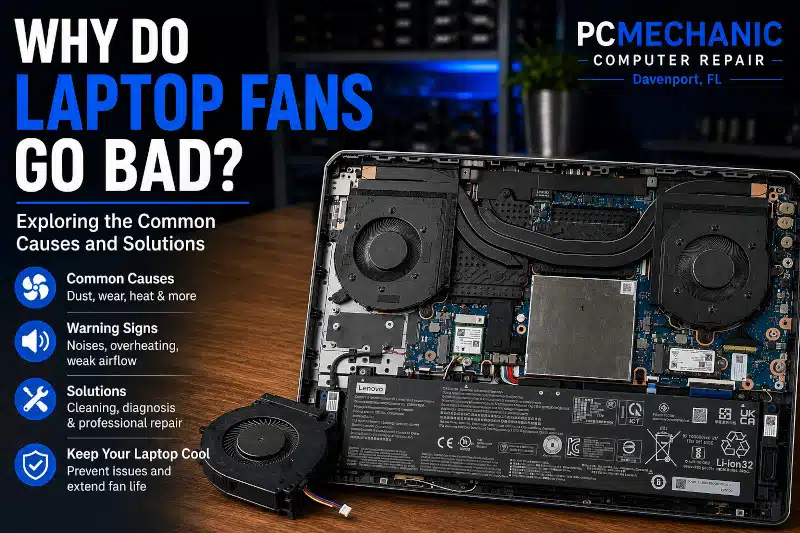
Why do laptop fans go bad? Laptop cooling fans can fail due to bearing wear, dust and debris, physical obstructions, electrical problems, or normal mechanical aging. Because a cooling fan contains moving parts and may operate for thousands of hours, it can eventually become noisy, slow down, operate intermittently, or stop spinning altogether.
However, a loud laptop fan doesn’t automatically mean the fan is failing. High processor temperatures, demanding applications, or heavy background activity can cause a perfectly functional fan to run faster. Understanding the difference between normal cooling behavior and actual fan failure can help determine whether your laptop needs attention.
Signs Your Laptop Fans May Be Failing
Laptop fans don’t always stop working suddenly. In many cases, they begin to show warning signs as the motor, bearings, or other internal components deteriorate.
Recognizing these symptoms can help distinguish a failing fan from a cooling system that is simply responding to higher temperatures.
Grinding, Rattling, or Clicking Noises
Unusual mechanical noises are among the most noticeable signs of laptop fan trouble.
A healthy cooling fan generally produces the sound of moving air. The sound may become louder when the laptop is working harder, but it should remain relatively smooth.
Grinding, rattling, clicking, buzzing, or scraping sounds are different.
These noises can indicate worn fan bearings, damaged fan blades, physical obstruction, or another mechanical problem.
The sound may initially occur only when the fan reaches a particular speed. As the problem progresses, however, the noise may become more frequent or persistent.
Laptop Fan Starts and Stops Unexpectedly
Laptop fans don’t necessarily run continuously. Modern systems can turn fans on and off or adjust their speed according to temperature.
Therefore, a fan stopping when the computer is cool can be completely normal.
The concern is inconsistent operation when the laptop is clearly generating substantial heat.
A failing fan may start briefly and then stop, struggle to reach normal speed, or operate intermittently as temperatures continue to rise.
Because fan behavior varies between laptop models, diagnosis should consider temperature, workload, and airflow together.
Reduced Airflow From the Laptop
A cooling fan can sometimes continue spinning while moving less air than it should.
You may notice less airflow from the exhaust vent than you remember, even though the laptop becomes increasingly hot.
Dust buildup, an obstructed heatsink, damaged fan blades, bearing wear, or reduced fan speed can all affect airflow.
However, weak airflow doesn’t automatically mean the fan itself has failed. A restriction elsewhere in the cooling system can produce similar symptoms.
Laptop Overheats During Normal Use
A failing cooling fan can contribute to excessive laptop temperatures.
If the fan cannot move enough air through the heatsink and exhaust system, heat may accumulate around the processor and other internal components.
The laptop may then become unusually hot, slow down, freeze, or shut down.
However, fan failure is only one possible cause of overheating. Restricted vents, dust buildup, poor heat transfer, heavy processor load, and other cooling issues can produce similar symptoms.
The article “My Laptop Overheating Symptoms: Signs Your Laptop Is Too Hot” explains the broader warning signs of excessive heat and other common causes of overheating.
Fan Error Appears During Startup
Some laptops can detect certain cooling-fan problems during startup.
Depending on the manufacturer and model, the computer may display a warning indicating that the cooling fan isn’t operating correctly.
You shouldn’t automatically assume the fan needs to be replaced based on a single message. However, repeated fan errors, combined with overheating, poor airflow, or abnormal fan behavior, warrant further diagnosis.
What Causes Laptop Fans to Go Bad?
Laptop cooling fans are mechanical and electrical components. Therefore, several conditions can eventually affect their ability to operate correctly.
Normal Bearing and Mechanical Wear
Mechanical wear is one of the most straightforward explanations for why laptop fans go bad.
A small electric motor spins the fan blades at high speed. Bearings allow that assembly to rotate smoothly.
Over thousands of operating hours, those moving parts can wear.
Bearing deterioration may initially cause subtle buzzing or rattling. Eventually, the fan may become louder, rotate inconsistently, or struggle to maintain the speed required for proper cooling.
The amount of time this takes varies considerably. Laptop design, fan quality, operating temperature, workload, and total hours of use can all affect longevity.
There isn’t a specific age when every laptop fan should be replaced.
Dust and Debris
Dust is one of the most common cooling system problems found in computers.
As air moves through a laptop, small amounts of dust, lint, pet hair, and other debris can enter through the ventilation openings.
Over time, this material may accumulate around the fan, heatsink, and exhaust vents.
Dust doesn’t necessarily mean that the cooling fan itself has failed. However, heavy accumulation can restrict airflow and force the cooling system to work harder.
Debris can also interfere with fan movement in more severe cases.
Therefore, it is important to distinguish between a dirty cooling system and an actual mechanical fan failure.
Physical Fan Obstruction
Foreign material can sometimes interfere directly with fan rotation.
Debris near the fan blades may cause clicking, scraping, or inconsistent operation.
Internal cables or other components can also create problems if they come into contact with a spinning fan.
Because laptop cooling assemblies are tightly packaged, even a small obstruction can create noticeable noise.
The laptop should be properly inspected before assuming that an unusual fan sound means the fan motor has failed.
Fan Motor or Electrical Problems
Laptop fans depend on electrical power and control signals from the motherboard.
A problem with the fan motor, internal wiring, connector, or control circuit can prevent normal operation.
In these situations, the fan may stop completely or behave intermittently.
Electrical fan problems can resemble mechanical failure, which is another reason diagnosis is preferable to ordering a replacement fan based solely on symptoms.
Manufacturing or Component Defects
Occasionally, a laptop cooling fan may fail earlier than expected because of a component defect.
The fan motor, bearings, electronics, or assembly may develop a problem despite relatively limited use.
Premature failure isn’t the most common explanation for every fan problem, but it is possible.
If a relatively new laptop develops unusual fan noise or cooling problems, the computer’s warranty status should also be considered before paying for third-party repair.
Long-Term Heavy Usage
Gaming, rendering, video editing, and other demanding activities can cause a laptop’s cooling fans to operate at higher speeds for longer periods.
This doesn’t mean that demanding applications directly damage a cooling fan.
The fan is designed to respond to heat.
However, a laptop used heavily for thousands of hours may accumulate more fan operating time than a computer used primarily for occasional web browsing or office work.
Over the long term, additional operating hours can contribute to normal mechanical wear.
Do Loud Laptop Fans Mean They Are Failing?
Not necessarily.
A laptop fan becomes louder when it spins faster. Higher fan speed moves more air through the cooling system, helping control processor and graphics temperatures.
For example, increased fan noise may be completely normal while:
- Gaming
- Editing or rendering video
- Installing large Windows updates
- Running demanding applications
- Performing intensive multitasking
- Using CPU- or GPU-heavy software
The type of sound is often more important than volume alone.
A strong rushing-air sound generally indicates that the fan is moving a significant amount of air.
Mechanical sounds such as grinding, scraping, rattling, clicking, or irregular buzzing are more concerning.
If the fan suddenly sounds different from its normal operation, especially when accompanied by excessive heat or reduced airflow, the cooling system may need inspection.
Laptop fan making unusual noises or struggling to keep your computer cool? Contact PCMechanic Computer Repair in Davenport, FL for professional laptop fan diagnosis and repair.

Can a Laptop Fan Going Bad Cause Overheating?
Yes.
The cooling fan moves air through the laptop’s heatsink and ventilation system. If the fan stops, spins too slowly, or cannot move enough air, the cooling system may struggle to remove heat effectively.
As temperatures rise, the laptop may increase fan speed if possible.
If cooling remains inadequate, the processor may reduce its performance through thermal throttling.
More severe temperature problems can contribute to freezing, instability, or unexpected shutdowns.
However, overheating doesn’t prove that the fan has failed.
A fully operational fan may run continuously because another condition is causing high temperatures.
That distinction is important when diagnosing cooling problems.
Why Gaming Laptop Fans Work Harder
Gaming laptops generally contain higher-performance processors and graphics hardware than basic laptops.
Those components can generate substantial heat under load.
As a result, gaming laptops commonly use more aggressive cooling systems. Many models have two fans, multiple heat pipes, larger heatsinks, or separate cooling paths for the CPU and GPU.
During gaming, both fans may run at high speeds for extended periods.
That behavior isn’t necessarily evidence of failure.
However, because gaming laptops may accumulate many hours of high-speed fan operation, normal mechanical wear can eventually become noticeable.
A sudden change in fan noise, airflow, or temperature behavior warrants more attention than high fan speed alone.
Are Laptop Cooling Fans Universal?
No.
Laptop cooling fans are generally model-specific.
Even laptops from the same manufacturer can use different fan designs depending on the processor, graphics configuration, motherboard layout, and chassis.
Differences can include:
- Fan dimensions
- Mounting points
- Electrical connectors
- Cable length
- Fan blade design
- CPU and GPU cooling configuration
- Single-fan or dual-fan arrangements
- Integrated fan and heatsink assemblies
For that reason, compatibility should be verified before ordering a replacement fan.
The laptop’s exact model number and existing cooling assembly are often important when identifying the correct component.
Can You Prevent Laptop Fans From Going Bad?
No maintenance routine can guarantee that a mechanical cooling fan will never fail.
However, good operating conditions can help the cooling system work efficiently.
Keep Ventilation Open
Use the laptop on a firm surface that doesn’t block its intake or exhaust vents.
Beds, blankets, couches, and other soft surfaces can obstruct ventilation openings.
Pay Attention to Changes in Fan Noise
A sudden change in fan sound can provide an early indication of a mechanical problem.
Persistent grinding, rattling, clicking, or scraping shouldn’t simply be ignored.
Avoid Excessive Dust Accumulation
Keeping the laptop’s environment reasonably clean can reduce the amount of dust and debris entering the cooling system.
Visible external vents should remain unobstructed.
Don’t Assume High Fan Speed Means Failure
A fast-running fan may simply be responding to heat.
Before replacing a fan, the underlying temperature and workload should be considered.
Replacing a functioning fan won’t correct overheating caused by a different cooling, hardware, or software problem.
When Laptop Fans Need Professional Diagnosis
A laptop cooling problem may require diagnosis if the fan develops persistent mechanical noise, airflow becomes unusually weak, overheating occurs during normal use, or the fan appears to stop operating when cooling is clearly needed.
Diagnosis is especially useful because several conditions can produce similar symptoms.
The problem may involve:
- The cooling fan
- Dust or restricted airflow
- The heatsink
- Thermal transfer
- Software creating excessive processor activity
- Another internal hardware problem
If your laptop fan is grinding, rattling, operating intermittently, or no longer moving enough air, my Laptop Repair in Davenport, FL service can help determine whether the cooling fan or another part of the cooling system is responsible.
Laptop Fans, Replacement, and Parts Compatibility
When diagnosis confirms that a cooling fan has failed, the correct replacement component must be identified.
Unlike desktop case fans, laptop fans usually aren’t interchangeable generic components.
The replacement must match the laptop’s cooling design, mounting arrangement, electrical connection, and physical dimensions.
Some laptops use a separately replaceable fan. Others use a more integrated cooling assembly.
Parts availability also varies by manufacturer and model.
Therefore, repair turnaround can depend on whether the correct replacement fan is readily available or needs to be ordered.
Why Choose PCMechanic for Laptop Fan Problems in Davenport, FL?
I have provided computer repair services in Davenport, Florida, since 2012.
When a laptop develops fan noise or overheating, I focus on identifying the root cause before recommending replacement parts.
A noisy laptop doesn’t automatically need a new fan. Likewise, an overheating laptop doesn’t automatically mean its cooling fan has failed.
By diagnosing the cooling problem first, I can determine whether the issue involves the fan, airflow, dust accumulation, thermal performance, software activity, or another condition.
PCMechanic Computer Repair is a home-based computer repair business. Customers arrange to drop off and pick up their laptops directly with me.
When replacement parts aren’t required, many problems can be addressed promptly. Fan replacement and other model-specific repairs depend on parts availability.
Frequently Asked Questions About Why Laptop Fans Go Bad
Why do laptop fans go bad?
Laptop fans can fail due to normal bearing wear, mechanical deterioration, dust and debris, physical obstructions, fan-motor problems, electrical issues, or occasional component defects. Because fans have moving parts, normal wear and tear can eventually affect their operation.
How can I tell if my laptop fan is failing?
Grinding, rattling, scraping, clicking, intermittent operation, weak airflow, overheating, or repeated fan error messages can indicate a cooling-fan problem. However, diagnosis may be necessary because other cooling issues can produce similar symptoms.
Does a loud laptop fan mean it needs to be replaced?
No. A healthy fan may become loud when the laptop is under heavy load because it spins faster to regulate temperature. Mechanical noises such as grinding, rattling, scraping, or clicking are more concerning than increased airflow noise alone.
Can dust cause a laptop fan to fail?
Dust can restrict airflow, accumulate around the fan and heatsink, and make the cooling system work harder. Heavy debris may also interfere with fan movement. However, dust accumulation doesn’t automatically mean the fan itself has mechanically failed.
Can a bad laptop fan cause overheating?
Yes. If the fan stops, spins too slowly, or cannot move sufficient air through the cooling system, internal temperatures may increase. However, overheating can have several other causes.
How long do laptop cooling fans last?
There is no universal lifespan for a laptop fan. Fan quality, laptop design, operating temperatures, workload, environmental conditions, and total operating hours can all influence how long the component lasts.
Can a laptop work with a failed cooling fan?
A laptop may continue operating temporarily, but using a computer with a confirmed failed cooling fan can lead to high temperatures, thermal throttling, instability, or shutdowns. The underlying cooling problem should be addressed rather than continuing demanding workloads.
Are replacement laptop fans universal?
No. Laptop cooling fans are usually model-specific. Dimensions, connectors, mounting points, cooling configurations, and fan assemblies can differ even between laptops from the same manufacturer.
Should I replace a noisy laptop fan immediately?
Not necessarily. Increased airflow noise can be normal during demanding workloads. However, persistent mechanical noises such as grinding, scraping, rattling, or clicking should be investigated to determine whether the fan is wearing out or another problem is present.
Get Help With Laptop Fan Problems in Davenport, FL
If your laptop fan is grinding, rattling, clicking, operating intermittently, or no longer providing adequate airflow, don’t assume the fan is the only possible cause.
A proper diagnosis can determine whether the problem involves the cooling fan, dust accumulation, restricted airflow, thermal performance, or another hardware or software condition.
Contact PCMechanic Computer Repair in Davenport, FL for professional laptop fan diagnosis and repair.