
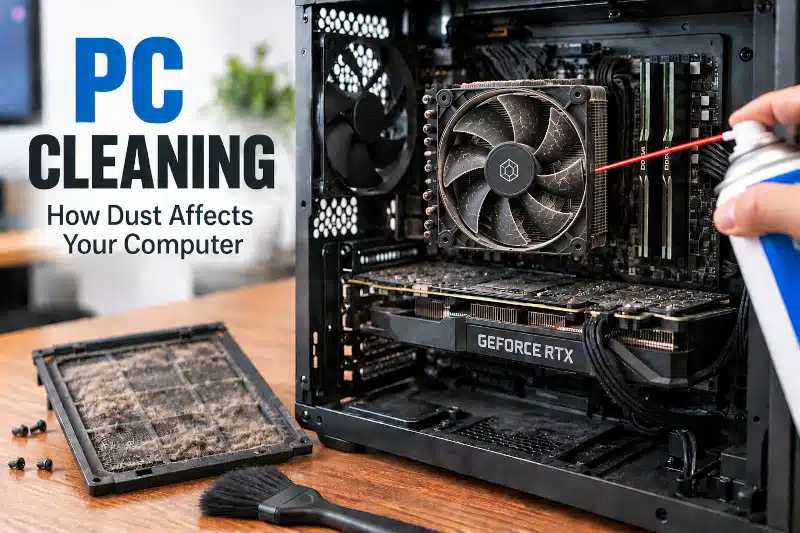
PC cleaning can help maintain proper airflow and cooling when dust accumulates inside your computer. Over time, dust can collect on fans, heatsinks, filters, vents, and other components. When buildup becomes excessive, the computer may have more difficulty dissipating heat from critical hardware.
However, a dusty computer does not automatically explain every overheating, noise, or performance problem. Cooling fans can fail, thermal problems can develop, and other hardware issues may produce similar symptoms.
At PCMechanic Computer Repair in Davenport, FL, I diagnose desktop and gaming computers with cooling, airflow, overheating, and performance problems. If dust is contributing to the problem, cleaning may be part of the solution. First, though, it is important to understand what is actually causing the symptoms.
Why PC Cleaning Matters
Desktop computers depend on airflow to remove heat generated by the processor, graphics card, power supply, and other components.
Fans pull cooler air into the case and exhaust warmer air. Meanwhile, CPU and GPU heatsinks transfer heat away from the components they cool.
Dust can gradually interfere with this process.
For example, buildup on an intake filter can reduce the amount of air entering the computer. Dust trapped between heatsink fins can also make it harder for air to move through them. Likewise, dirty fan blades may reduce cooling efficiency.
As a result, internal temperatures may increase when dust buildup becomes severe enough to restrict airflow.
However, the amount of dust a computer collects varies considerably. The room environment, flooring, pets, case design, filters, fan configuration, and placement of the computer can all affect how quickly dust accumulates.
Therefore, there is no single cleaning schedule that works for every PC.
Where Does Dust Accumulate Inside a PC?
Dust tends to collect anywhere air enters, exits, or passes through a computer.
Common locations include:
- Front intake filters
- Case fans
- CPU cooler heatsinks
- Graphics card heatsinks and fans
- Radiators used with liquid cooling systems
- Power supply vents and filters
- Bottom case filters
- Ventilation openings
- Interior surfaces around airflow paths
Computers placed directly on or near the floor may accumulate more dust, hair, and debris than systems on a clean, elevated surface.
Pet hair can also contribute to buildup, particularly around filters and intake openings.
Therefore, inspecting the computer periodically can tell you much more than following an arbitrary monthly cleaning schedule.
Can Dust Make a Computer Overheat?
Yes, excessive dust can contribute to overheating, particularly when it restricts airflow through vents, filters, fans, radiators, or heatsinks.
However, this distinction is important:
Dust is one possible cause of high temperatures, not the only cause.
A computer can overheat even when it is perfectly clean.
Other possible causes include:
- A failing cooling fan
- Poor case airflow
- An improperly installed CPU cooler
- Cooling-system problems
- High ambient room temperatures
- A blocked intake or exhaust
- Hardware operating at unusually high temperatures
- An inadequate cooling configuration
For gaming computers, powerful CPUs and graphics cards can produce considerable heat under load. Consequently, case airflow becomes especially important.
If you are experiencing temperature issues while gaming, my article, “CPU Overheating While Gaming,” explains other causes to consider.
Can PC Cleaning Improve Performance?
Sometimes, but cleaning should not be treated as a general performance upgrade.
If dust has significantly restricted cooling and the CPU or GPU is reducing performance due to excessive temperatures, fixing the cooling issue may allow the hardware to operate normally again.
However, cleaning a computer that already has adequate airflow and normal temperatures will not suddenly make its processor, RAM, SSD, or graphics card faster.
A slow computer may instead have a Windows problem, insufficient memory, storage issues, malware, aging hardware, or another underlying condition.
Therefore, if your computer has become unusually slow, a diagnosis is more useful than assuming dust is to blame.
Signs Your PC May Need Cleaning
You do not necessarily need to disassemble your computer to recognize excessive dust buildup.
Visible dust on intake filters is one of the easiest signs. You may also notice dust collecting around case vents or fan openings.
Other possible signs include:
- Heavy dust visible through the case
- Clogged intake filters
- Dust covering fan blades
- Fans running harder than usual
- Higher operating temperatures
- Reduced airflow from exhaust vents
- Dust packed into heatsink fins or radiators
These symptoms can indicate that inspection and cleaning are appropriate.
However, fan noise or high temperatures alone do not prove that the computer is dirty. A failing fan or another cooling problem may produce similar symptoms.
How Often Should You Clean Your PC?
There is no universal answer.
The original version of this article recommended cleaning a PC every month. However, that is unnecessary for many computers. The appropriate interval depends largely on the environment and how quickly the system accumulates dust.
Instead of relying on a fixed schedule, periodically inspect accessible filters and ventilation openings.
A computer in a relatively clean room with effective dust filters may remain clean for a considerable period. In contrast, a PC in a dusty environment or in a home with pets may require more frequent attention.
The computer’s condition should determine when cleaning is necessary.
Basic PC Cleaning Precautions
Some basic exterior cleaning and filter maintenance can be performed without extensive computer-repair experience.
Before cleaning a desktop computer, shut it down completely and disconnect it from power.
If the case has removable dust filters, you can inspect them for buildup. Make sure a cleaned filter is completely dry before reinstalling it.
For exterior surfaces, use materials appropriate for electronic equipment and prevent liquids from entering the computer.
If you use compressed air inside a PC, use it carefully. Avoid allowing fans to spin uncontrollably while blowing air through them.
Most importantly, do not force components, connectors, or cables out of the way to reach dust.
If you are uncomfortable working inside the computer, there is no reason to risk damaging expensive hardware to clean it.
What Should You Avoid When Cleaning a PC?
Cleaning a computer incorrectly can create problems that did not exist beforehand.
Avoid spraying household cleaners directly onto computer components. Likewise, do not pour or spray liquids inside the case.
You should also avoid aggressively brushing circuit boards or delicate connectors.
Standard household vacuum cleaners are generally not my preferred choice for cleaning internal computer components. Instead, use methods intended for electronic equipment and avoid unnecessary contact with sensitive hardware.
Additionally, be careful around the power supply. A power supply is not a component that I recommend opening for routine cleaning.
If dust has accumulated inside the power supply enclosure, decisions about cleaning or replacement should be based on the unit’s condition rather than on attempting to disassemble it.
PC Cleaning and Case Airflow
Cleaning and airflow work together.
A clean computer can still have poor cooling if the case cannot move enough air through the system. Similarly, an excellent airflow configuration can become less effective when filters and heatsinks become heavily clogged.
Air should have a reasonable path into and out of the case.
For gaming PCs, fan placement, case design, component temperatures, and cable management can all influence cooling performance.
If your existing case has limited ventilation, my article about the Benefits of Upgrading a PC Case explains how a better case can improve airflow, component compatibility, and the overall system layout.
I’ve also had customers bring in gaming computers for case swaps specifically to improve airflow and appearance. In those situations, cleaning the existing computer alone would not address limitations caused by the case itself.
When Cleaning Doesn’t Fix the Problem
This is where diagnosis becomes important.
Suppose you clean a dusty computer, but the CPU continues overheating. In that case, the cooling system may have another problem.
Likewise, a computer that continues to shut down, freeze, or become unstable after cleaning may have an unrelated hardware or Windows issue.
Possible causes can include cooling failures, power supply problems, memory issues, storage problems, Windows corruption, or other hardware faults.
Cleaning should therefore be viewed as maintenance rather than a universal repair.
If the symptoms continue after obvious airflow restrictions have been addressed, troubleshooting the computer can help identify the actual cause.
Need Help With an Overheating or Dusty PC?
If your computer is running unusually hot, becoming noisy, shutting down, or showing other signs of cooling trouble, the problem may involve more than dust.
Contact PCMechanic Computer Repair in Davenport, FL for professional computer diagnosis and help determining the cause of the problem.

Preventing Excessive Dust Buildup
You cannot completely prevent dust from entering an air-cooled computer. Moving air naturally carries small particles with it.
However, a few practical measures can help reduce excessive accumulation.
Keep accessible case filters reasonably clean. Also, avoid blocking the computer’s intake and exhaust openings.
If possible, place the computer where it has adequate space around its ventilation openings. Avoid pushing the case tightly against a wall or furniture that blocks exhaust airflow.
PC placement can matter as well. A computer in an area that collects a lot of dust or pet hair may require more frequent inspection.
Finally, make sure filters remain installed where the case manufacturer intended them to be used. Removing a dirty filter without replacing or cleaning it may allow more debris into the computer.
PC Cleaning for Gaming Computers
Gaming PCs often require particular attention to airflow because high-performance hardware can generate significant heat.
A gaming computer may have multiple intake and exhaust fans, a large graphics card, an air cooler, or an all-in-one liquid cooler with a radiator.
Each of these components can collect dust.
Radiator fins and heat sinks are especially important because airflow must pass through relatively narrow spaces. Heavy buildup can interfere with that airflow.
However, gaming PC temperatures should always be considered in context. A system running warm under a demanding game does not necessarily have a cooling problem.
Temperatures, fan behavior, airflow, workload, and system stability should be evaluated together.
Frequently Asked Questions
Can dust damage a computer?
Heavy dust accumulation can interfere with cooling and contribute to higher operating temperatures. However, the effect depends on where the dust accumulates and whether it restricts airflow or cooling.
Does dust make a PC slower?
Not directly in most cases. However, if dust contributes to excessive temperatures and the hardware reduces performance to control heat, cooling problems can affect performance.
How often should I clean my gaming PC?
There is no universal schedule. Inspect filters and visible areas periodically and clean the system when buildup becomes significant. PCs in dusty environments or homes with pets may require more frequent attention.
Is compressed air safe for cleaning a computer?
Compressed air is commonly used for PC cleaning, but it should be used carefully. Keep the computer powered off and avoid allowing fans to spin excessively while cleaning them.
Should I open my power supply to clean it?
No. I do not recommend opening a power supply as part of routine PC cleaning.
Will cleaning fix an overheating computer?
It can help if dust is restricting airflow. However, overheating can also result from fan failures, cooler problems, poor airflow, high ambient temperatures, or other issues. If temperatures remain high after cleaning, further diagnosis may be necessary.
Can you diagnose a PC that still overheats after cleaning?
Yes. I can diagnose overheating, fan, airflow, stability, and related hardware problems in desktop and gaming computers.
Get Help With PC Cooling and Performance Problems
PC cleaning can help keep airflow paths, filters, fans, and heatsinks free from excessive dust. However, a clean computer can still overheat or experience performance problems when something else is wrong.
If your computer continues to run hot, make excessive fan noise, shut down, or behave unpredictably, I can diagnose the system and determine whether the problem involves cooling, airflow, hardware, or Windows.
Contact PCMechanic Computer Repair in Davenport, FL today to schedule professional computer diagnosis and repair.