
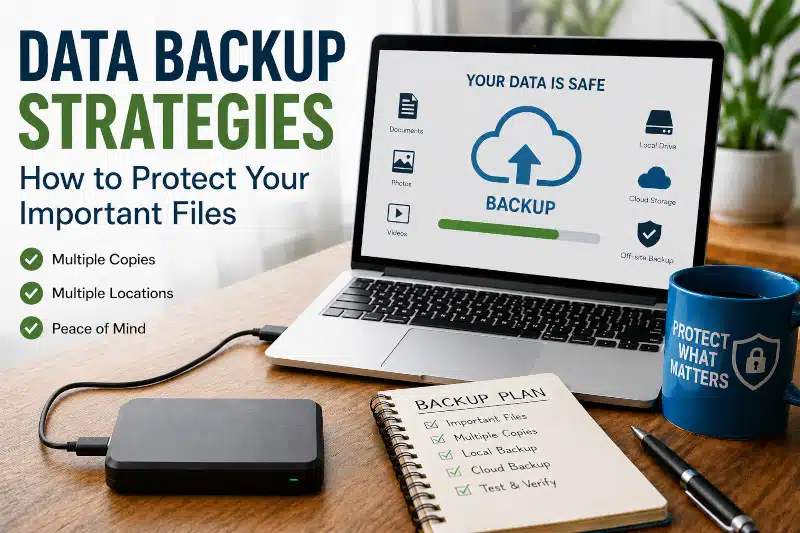
Data backup strategies help protect important documents, family photos, videos, financial records, and other files from hardware failure, accidental deletion, malware, and unexpected computer problems. If the only copy of an important file is on a single computer or storage device, losing that device could mean losing the file as well.
Fortunately, a good backup strategy doesn’t need to be complicated. The goal is to maintain additional copies of the files that matter and make sure you can recover them when necessary.
A combination of local and off-site backups can provide much stronger protection than relying on a single copy. Understanding what to back up, where to store those copies, and how often to update them can help you build a practical backup plan.
Why Are Data Backup Strategies Important?
Computers and storage devices don’t last forever.
Hard drives can develop mechanical problems, SSDs can fail, Windows can become corrupted, and malware can damage or encrypt files. In addition, accidental deletion can occur even when the computer itself is working perfectly.
The consequences become much more serious when the computer contains the only copies of irreplaceable information.
Important data may include:
- Family photos and videos
- Personal documents
- Financial and tax records
- School or work files
- Business documents
- Spreadsheets
- Scanned records
- Creative projects
- Other files that would be difficult or impossible to replace
My article Data Loss: Consequences of Not Backing Up Your Data explains the potential impact of losing important files and why waiting until a storage device fails can leave you with fewer options.
A backup strategy gives you another place to retrieve your information when something happens to the original.
What Files Should You Back Up?
You don’t necessarily need to treat every file on a computer with the same priority.
Windows, device drivers, and many applications can usually be downloaded or reinstalled. Personal information is different.
Start by identifying the files you cannot easily replace.
For most people, that means documents, photos, videos, financial records, schoolwork, business files, and other personal data.
Also consider where those files are stored. Important information may exist in:
- Documents
- Pictures
- Videos
- Desktop
- Downloads
- Music
- Application-specific folders
- Other personally created folders
Don’t assume that everything important is automatically stored in a single Windows folder.
Once you know what needs protection, you can choose appropriate backup destinations and determine how frequently those files should be copied.
Follow the 3-2-1 Backup Strategy
One of the most useful frameworks for protecting important information is the 3-2-1 backup strategy.
The concept is straightforward:
Keep Three Copies of Important Data
Maintain your original files plus two additional copies.
For example, your primary files may remain on the computer while you maintain one backup on external storage and another at a separate location.
If one copy becomes unavailable, you still have alternatives.
Use More Than One Storage Location or Method
Avoid relying entirely on a single storage device.
For example, keeping the original files on your computer and another copy on an external drive provides some protection against failure of the computer’s internal storage.
However, both devices may still be vulnerable if they remain together during theft, fire, electrical damage, or another event affecting the same location.
Keep One Copy Off-Site
At least one backup should exist in a location physically separate from the primary computer.
Depending on your needs, that might involve a reputable cloud backup service or another secure off-site location.
The purpose is to prevent a single event from destroying every available copy.
The 3-2-1 approach isn’t the only possible backup strategy. However, it provides an easy way to think about redundancy and avoid relying on a single backup device.
Local Data Backup Strategies
A local backup stores another copy of your files on storage you control directly.
Common options include:
- External hard drives
- External SSDs
- USB storage for smaller amounts of data
- Network-attached storage in more advanced environments
Local backups have several advantages.
You can access the files without relying on an Internet connection, and transferring large amounts of data can be relatively fast. An external drive can also provide a convenient way to preserve files before certain repairs or computer changes.
However, an external drive isn’t automatically a complete backup strategy.
If the drive remains connected to the computer at all times, both devices may be exposed to some of the same risks. Malware, electrical problems, theft, accidental deletion, or physical damage could affect both copies.
Therefore, local storage works best as part of a broader backup plan rather than as the sole protection for irreplaceable files.
Cloud and Off-Site Backup Strategies
Cloud backup can provide an off-site copy of important files.
This is valuable because the backup isn’t physically located next to the computer. If the computer and local backup are damaged or stolen together, an off-site copy may still be available.
Cloud-based protection can also automate much of the backup process, depending on the service and configuration.
However, don’t assume that simply putting files “in the cloud” guarantees complete protection.
Consider factors such as:
- Available storage capacity
- Account security
- Multi-factor authentication
- File-version history
- Retention policies
- Recovery options
- Internet upload speed
- Subscription costs
- Which folders the service actually protects
It’s also important to understand whether you’re using a true backup service or primarily a file-synchronization service.
Backup vs. Sync: What’s the Difference?
Backup and synchronization can appear similar because both may create copies of files in another location. However, they serve different purposes.
Synchronization primarily keeps files consistent between devices or locations.
For example, when you edit a synchronized document on one device, the updated version may appear on your other devices. Likewise, deleting a synchronized file may cause that deletion to propagate elsewhere, depending on the service and configuration.
Backup focuses on preserving recoverable copies of your information.
A good backup system may provide previous versions or historical copies that allow you to recover from accidental changes, deletion, corruption, or other problems.
Some cloud services provide both synchronization and recovery features. However, you should understand exactly how your chosen service handles deleted files, previous versions, and retention.
Don’t assume synchronization alone provides all the protection of a dedicated backup strategy.
Combining Local and Cloud Backups
For many people, combining local and off-site storage provides a practical balance.
A local backup can provide quick access to large amounts of data, while an off-site copy protects against events that affect the computer and nearby storage simultaneously.
For example, you might keep:
- Original files on the computer
- A local copy on external storage
- Another copy through an appropriate off-site or cloud backup solution
That arrangement closely follows the principles behind the 3-2-1 strategy.
The specific products or services matter less than maintaining independent copies and knowing that you can recover them when needed.
Need help protecting important files before a repair, Windows reinstallation, or computer replacement? Contact PCMechanic Computer Repair in Davenport, FL for professional data backup and file transfer assistance.

How Often Should You Back Up Your Files?
Backup frequency should depend on how often your important files change.
Ask yourself a simple question:
How much recent work or personal data could I afford to lose?
If you create or modify important files every day, backing up once every few months would leave a large gap. On the other hand, someone whose important files rarely change may not need the same schedule.
Possible backup frequencies include:
- Daily
- Several times per week
- Weekly
- After important projects or major changes
- Automatically as files change
The right schedule depends on the value of the data and how frequently you update it.
Automation can be particularly useful because a backup strategy only works if backups actually occur.
Don’t Leave Your Only Backup Connected All the Time
An external drive provides useful protection against failure of the computer’s internal storage. However, leaving the only backup permanently connected can expose both copies to some of the same threats.
For example, certain malware may affect accessible storage. Electrical problems or physical damage could also affect devices connected to the same computer.
If an external drive contains one of your important backup copies, consider whether it needs to remain connected continuously.
The best approach depends on your backup software and overall strategy. However, the broader principle remains the same: avoid creating a situation in which a single problem can eliminate every copy.
Test Your Backups Before You Need Them
Creating a backup isn’t the end of the process.
You should periodically confirm that the backup actually contains the files you expect and that you can access them.
A backup that fails silently provides little protection.
Occasionally check:
- Whether recent files appear in the backup
- Whether expected folders are included
- Whether the destination has enough available space
- Whether automated backups are still running
- Whether you can open or restore selected files
- Whether your cloud account remains accessible
You don’t want to discover a backup problem only to find the original files are already gone.
Common Data Backup Mistakes to Avoid
Even people who make backups can unintentionally leave important files vulnerable.
Keeping Only One Copy
Copying a file to an external drive and deleting the original doesn’t create a backup. You still have only one copy.
Backing Up Too Infrequently
A six-month-old backup may save older files, but it won’t contain everything you’ve created since then.
Forgetting Important Folders
Files stored on the Desktop, in Downloads, or inside application-specific folders can easily be overlooked.
Assuming Sync Is the Same as Backup
Synchronization can be useful, but you should understand how deletions, changes, and file versions behave.
Never Testing the Backup
A backup should be checked occasionally to make sure the files are actually recoverable.
Keeping Every Copy in the Same Place
Multiple drives installed in the same computer provide redundancy against drive failure, but they don’t protect as well against theft, fire, or other location-wide events.
Back Up Important Files Before Major Computer Work
Before major operating-system repairs, hardware changes, or other significant computer work, protecting important files is a sensible precaution.
For example, a severely damaged Windows installation may eventually require my Windows Installation & Reinstallation Service. Whenever the storage device remains accessible, I determine whether important personal files can be backed up before reinstalling Windows.
You should also consider backing up important information before making major changes yourself.
A current backup provides an additional layer of protection in case something unexpected happens.
Moving Files to a New Computer
Buying a replacement computer creates another common data-management situation.
Documents, photos, videos, and other personal files may need to move from the old computer to the new one.
However, file transfer isn’t the same as a complete backup strategy. Once the files exist only on the new computer, you’re back to having a single copy.
After moving to a new PC, establish a backup plan for the new system rather than assuming the old computer will remain a reliable backup indefinitely.
If you’ve purchased a new computer and want help configuring Windows, installing requested software, and transferring accessible personal files, my New Computer Setup in Davenport, FL service provides a more complete transition to the new system.
When You Need Help With Data Backup and File Transfer
Not everyone wants to handle file transfers or backup preparation themselves.
You may need help preserving important files before a computer repair, Windows reinstallation, storage change, or computer replacement.
My Data Backup & File Transfer in Davenport, FL service can help when the source computer or storage device remains readable and accessible.
I can assist with:
- Backing up accessible personal files
- Copying files to suitable external storage
- Transferring files between computers
- Preserving accessible data before certain Windows services
- Moving files from an old computer
- Evaluating the amount of data that needs to be transferred
However, this service isn’t advanced data recovery. I don’t perform laboratory-style recovery from physically failed drives or recover files that were intentionally or accidentally deleted.
When a storage device has physically failed or become unreadable, a specialized data-recovery company may be necessary.
Frequently Asked Questions About Data Backup Strategies
What is the best data backup strategy?
There isn’t one perfect strategy for everyone. However, maintaining multiple copies across local and off-site storage provides much stronger protection than relying on one device. The 3-2-1 approach offers a useful starting framework.
What does the 3-2-1 backup strategy mean?
It generally means maintaining three copies of important data, using more than one storage type or location, and keeping at least one copy off-site.
Is an external hard drive enough for backup?
An external drive is useful, but relying on a single external drive as your only backup still poses a risk. Combining local storage with another independent or off-site copy provides stronger protection.
Is cloud storage the same as backup?
Not always. Some cloud services primarily synchronize files, while others provide dedicated backup, versioning, and recovery features. Review how your service handles deletion, previous versions, and retention.
How often should I back up my computer?
It depends on how frequently your important files change and how much recent information you could afford to lose. Frequently changing files generally require more frequent backups.
Should I leave my backup drive connected?
That depends on the backup method. However, leaving your only backup permanently connected can expose it to some of the same threats as the computer. Multiple independent copies provide better protection.
Should I back up Windows and my programs?
Your highest priority should usually be irreplaceable personal files. Windows and many programs can be reinstalled, although some backup solutions can also create complete system images.
How do I know whether my backup is working?
Periodically check that recent files appear in the backup and test whether you can access or restore selected files. Don’t rely solely on the assumption that an automated process is working.
Can files be backed up if Windows won’t start?
Sometimes. If Windows won’t boot but the storage device remains healthy and readable, the files may still be accessible through another method.
What if my hard drive has physically failed?
Ordinary backup and file-transfer methods may no longer work. A physically failed or unreadable storage device may require a specialized data-recovery service.
Protect Your Important Files Before Something Goes Wrong
Effective data backup strategies don’t need to be complicated. They need to create reliable additional copies of the files you cannot afford to lose.
Start by identifying your important information. Then choose appropriate local and off-site backup methods, establish a schedule, and periodically verify that your backups actually work.
Most importantly, don’t wait for a storage failure or Windows problem before thinking about your files.
If you need help backing up accessible files, preparing for computer repair, or transferring personal data between computers, contact PCMechanic Computer Repair for professional Data Backup & File Transfer services in Davenport, FL.