Signs of hard drive failure can appear gradually or develop without much warning. Your computer may become unusually slow, Windows may struggle to start, files may become inaccessible, or a mechanical hard drive may begin making unusual noises.
However, these symptoms do not automatically mean the storage drive has failed. Windows corruption, malware, insufficient memory, overheating, and other hardware problems can produce similar behavior.
At PCMechanic Computer Repair in Davenport, FL, I diagnose storage problems to determine whether the hard drive or solid-state drive is actually causing the symptoms. If the drive remains readable, I may also be able to back up or transfer accessible files before replacing it.
What Does a Hard Drive Do?
Your computer’s storage drive holds Windows, installed applications, documents, photos, videos, and other files. Unlike RAM, the storage device retains this information after you shut down the computer.
Computers commonly use one of two types of storage:
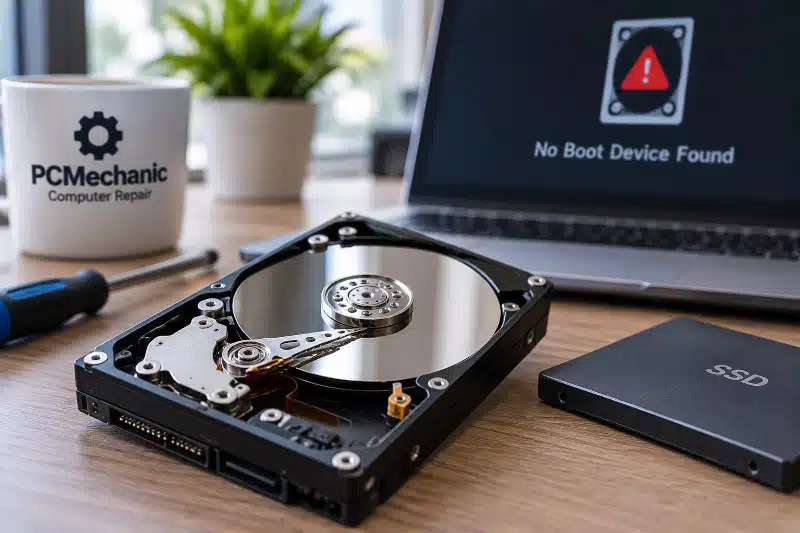
- Hard disk drive (HDD): A mechanical device containing spinning platters and moving read/write heads.
- Solid-state drive (SSD): A storage device that uses flash memory and contains no moving mechanical parts.
Both types can fail. However, the warning signs may differ.
A failing mechanical hard drive may develop clicking, grinding, or other unusual sounds. An SSD cannot produce mechanical noises, so SSD failure often manifests as performance problems, errors, detection issues, or an inability to access data.
Common Signs of Hard Drive Failure
Storage problems don’t always produce one obvious warning. Instead, you may notice several symptoms that become increasingly frequent.
Possible signs of hard drive failure include:
- Extremely slow startup or file access
- Windows freezing during disk activity
- Files or folders becoming inaccessible
- Read or write errors
- Corrupted files
- Windows failing to boot
- The drive disappearing from Windows or the BIOS
- S.M.A.R.T. warnings
- Repeated storage-related errors
- Clicking or grinding noises from a mechanical HDD
One symptom alone doesn’t prove that the drive is failing. Proper diagnosis helps distinguish a storage problem from issues with Windows, memory, the motherboard, power, or other hardware.
Slow Performance Can Be a Sign of Hard Drive Failure
A computer that suddenly becomes extremely slow may have a storage problem.
For example, Windows may take much longer than usual to start. Applications may become unresponsive, folders may take a long time to open, or the computer may freeze while accessing files.
However, slow performance can have many causes.
Insufficient RAM, excessive background programs, malware, Windows corruption, overheating, and aging hardware can also make a computer sluggish. Therefore, I don’t recommend replacing a storage drive based on slow performance alone.
If the computer needs software optimization rather than hardware replacement, my Computer Tune-Up service addresses software-related performance problems. A tune-up, however, cannot repair a physically failing storage drive.
File Problems Can Be Signs of Hard Drive Failure
Problems opening files can sometimes indicate storage trouble.
You might encounter documents that no longer open correctly, folders that produce errors, or files that Windows can no longer read.
However, file corruption does not always mean the drive itself has physically failed. Software problems, Windows corruption, interrupted writes, application errors, malware, and other issues can also damage files.
For that reason, I look at the overall condition of the computer and storage device rather than diagnosing a drive failure based on a single corrupted file.
If multiple files become inaccessible or errors persist during normal storage activity, the drive warrants closer examination.
Unusual Noises From a Mechanical Hard Drive
Unusual sounds are among the more concerning signs of hard drive failure in computers with mechanical HDDs.
A traditional hard drive normally produces some operating noise. However, repeated clicking, grinding, scraping, or other sudden sounds can indicate a mechanical problem.
If a hard drive contains important files and begins making abnormal mechanical noises, repeatedly restarting the computer or attempting to access the drive may not be a good idea.
Continued operation of a severely failing mechanical drive can make accessing the data more difficult.
This warning applies specifically to mechanical hard drives. SSDs contain no moving parts, so they will not produce clicking or grinding noises when they fail.
Windows Will Not Boot
A computer that suddenly stops booting may have a failed or failing storage drive.
Windows depends on the storage device to load the operating system and system files. If the computer cannot reliably read those files, startup may fail.
You might encounter:
- Automatic Repair loops
- Missing operating system errors
- Boot device errors
- Extremely long startup times
- Windows freezing during startup
- A computer that returns directly to the BIOS
However, a computer that won’t boot doesn’t necessarily have a failed drive.
Windows corruption, motherboard problems, RAM issues, BIOS configuration, power problems, and other hardware failures can produce similar symptoms.
That is why diagnosis comes before drive replacement.
The Drive Disappears From Windows or BIOS
Another possible warning sign occurs when the computer stops detecting the storage device.
A drive may appear intermittently, disappear after restarting, or fail to appear in Windows altogether.
However, the drive itself isn’t always responsible. A faulty cable, a connection problem, a motherboard issue, a power problem, or an incorrect BIOS configuration can sometimes prevent the computer from detecting a healthy drive.
I can evaluate the storage device and related hardware to determine where the problem originates.
What Is a S.M.A.R.T. Warning?
Many modern HDDs and SSDs support S.M.A.R.T. (Self-Monitoring, Analysis and Reporting Technology).
The drive monitors various operating conditions and may report information that helps identify developing problems.
A S.M.A.R.T. warning deserves attention, particularly when the computer also exhibits storage-related symptoms.
However, S.M.A.R.T. monitoring doesn’t guarantee you will receive advance notice of every failure. A drive can sometimes develop serious problems without providing a useful warning first.
For that reason, regular backups remain important even when a storage device appears healthy.
Can a Hard Drive Fail Without Warning?
Yes.
Although some storage drives show noticeable warning signs before failure, others can stop working unexpectedly.
A drive might function normally one day and become inaccessible the next. Electrical problems, controller failures, mechanical failures, flash-memory problems, and other faults can occur with little warning.
This is why important files should never exist in only one location.
Waiting for signs of hard drive failure before creating your first backup puts your files at unnecessary risk.
HDD Failure vs. SSD Failure
Mechanical hard drives and SSDs perform the same basic storage function, but they fail in different ways.
An HDD contains mechanical components. Therefore, physical wear or damage can sometimes produce audible symptoms such as clicking or grinding.
An SSD uses flash memory and electronic controllers. It has no spinning platters or moving read/write heads.
Possible SSD problems may include:
- The SSD disappearing from the system
- Read or write errors
- Severe performance problems
- Files becoming inaccessible
- Windows failing to boot
- The BIOS no longer detecting the SSD
Because SSDs don’t provide the same mechanical warning signs as HDDs, diagnosis often depends more heavily on system behavior, drive health information, and hardware testing.
Can Freezing and Crashing Be Signs of Hard Drive Failure?
Sometimes, these symptoms are not specific enough to diagnose drive failure on their own.
A computer may freeze when Windows repeatedly struggles to read information from a problematic storage device. Likewise, storage errors can sometimes contribute to crashes or startup problems.
However, RAM issues, overheating, driver issues, Windows corruption, malware, motherboard problems, and other hardware problems can also cause freezing and crashes.
I evaluate the symptoms and hardware before recommending a replacement.
What to Do When You See Signs of Hard Drive Failure
If you notice signs of hard drive failure, first consider the importance of the files stored on the computer.
When the drive remains healthy enough to read reliably, it may be possible to back up important documents, photos, and other files.
However, the situation changes when a mechanical hard drive makes abnormal noises, repeatedly disconnects, becomes extremely difficult to read, or appears to have physically failed.
Repeated attempts to access a severely failing drive can potentially make the situation worse. If the files are irreplaceable, a specialized data-recovery company may be the appropriate next step.
I do not provide advanced recovery from physically failed or unreadable storage devices.
Concerned About a Failing Hard Drive?
If your computer has become unusually slow, stopped booting, developed storage errors, or shows other signs of hard drive failure, contact PCMechanic Computer Repair in Davenport, FL for professional diagnosis.

Can I Back Up Files From a Failing Hard Drive?
Possibly. It depends on the condition of the drive.
If Windows won’t start but the storage device itself remains healthy and readable, I may still be able to access and copy important personal files.
My Data Backup & File Transfer service covers accessible files on readable storage devices. It does not include advanced recovery from physically failed drives, severely damaged media, unreadable storage devices, or deleted files.
This distinction matters because ordinary file transfer and professional data recovery are very different services.
If the drive contains irreplaceable information and has physically failed, a specialized data-recovery company may be necessary.
Should You Replace a Failing HDD With an SSD?
In many computers, yes.
If a mechanical hard drive has failed and the computer is still worth repairing, replacing the HDD with an SSD can restore storage functionality and improve everyday responsiveness.
SSDs generally provide much faster access times than traditional mechanical hard drives. Windows can start faster, applications can load more quickly, and normal file operations often feel much more responsive.
However, compatibility and the computer’s overall condition should come first.
My Computer Hardware Upgrades service includes SSD and storage upgrades when they make sense for the computer.
What Happens After Replacing a Failed Windows Drive?
Replacing the physical drive is only part of the repair when the failed device contained Windows.
The replacement storage device may also require:
- Windows installation
- Hardware drivers
- Windows updates
- Activation verification
- System configuration
- Restoration of accessible personal files when available
My Windows Installation & Reinstallation Service covers operating-system installation on replacement storage, including driver setup, Windows updates, and system testing.
If the old drive remains readable enough to copy files, I may also be able to transfer accessible personal data to the replacement system.
Why Proper Diagnosis Matters
Several computer problems can look like storage failure.
For example, Windows corruption may prevent the computer from booting even though the SSD or hard drive remains healthy. Faulty RAM can cause crashes and corrupted data. A power or motherboard problem may prevent the system from detecting a storage device.
Replacing the drive without determining the actual cause can therefore waste money and leave the original problem unresolved.
I diagnose the computer first and recommend replacing the storage when the evidence points to the drive itself.
Signs of Hard Drive Failure in Gaming PCs
Storage failure can affect gaming PCs just like any other computer.
Possible symptoms include games taking unusually long to load, installations failing, files becoming corrupted, Windows freezing during storage activity, or the computer failing to boot.
However, poor gaming performance alone does not mean the storage drive is failing. GPU, CPU, RAM, cooling, Windows, drivers, and other problems can affect game performance.
If the storage device is at fault, I can determine whether a replacement or an SSD upgrade makes sense for the system.
Frequently Asked Questions About Signs of Hard Drive Failure
What are the most common signs of hard drive failure?
Possible warning signs include unusually slow file access, boot problems, inaccessible files, read or write errors, S.M.A.R.T. warnings, a drive disappearing from the system, and unusual noises from a mechanical HDD.
Does a clicking hard drive mean it is failing?
Repeated or abnormal clicking from a mechanical hard drive can indicate a serious mechanical problem. If the drive contains important files, avoid unnecessary use and consider whether specialized data recovery may be necessary.
Can an SSD fail without warning?
Yes. SSDs can develop electronic, controller, or flash-memory problems without producing the mechanical warning sounds associated with traditional hard drives.
Can a bad hard drive cause a computer to run slowly?
Yes, a failing storage drive can cause severe slowdowns when Windows struggles to read or write data. However, many other problems can also cause slow performance, so diagnosis is important.
Can a failing drive prevent Windows from booting?
Yes. If Windows cannot reliably access the operating-system files on the drive, startup can fail. However, Windows corruption and other hardware problems can cause similar symptoms.
Can you recover files from a failed hard drive?
I don’t provide advanced data recovery from physically failed or unreadable storage devices. If the drive remains readable, I may be able to back up or transfer accessible files. Physically failed drives may require a specialized data-recovery company.
Should I continue using a hard drive that is making unusual noises?
If a mechanical hard drive begins making abnormal clicking, grinding, or scraping noises and contains important data, continuing to use it may increase the risk of additional problems. Consider professional evaluation before repeatedly attempting to access it.
Should I replace an old hard drive with an SSD?
An SSD can be an excellent replacement for a mechanical hard drive when the computer supports it and remains worth repairing. The decision should depend on compatibility, computer condition, performance needs, and repair cost.
Professional Diagnosis for Signs of Hard Drive Failure
Signs of hard drive failure should not be ignored, but they also shouldn’t lead you to replace the drive without confirming the cause.
At PCMechanic Computer Repair, I can diagnose storage-related problems and determine whether the hard drive, SSD, Windows installation, or another component is responsible.
If the drive remains readable, I may also be able to back up accessible personal files before replacing it. For physically failed storage devices or situations requiring advanced data recovery, I’ll explain that limitation rather than attempt a service that isn’t appropriate for the drive’s condition.
If your computer shows signs of hard drive failure, contact PCMechanic Computer Repair in Davenport, FL today to schedule professional computer diagnosis and repair.