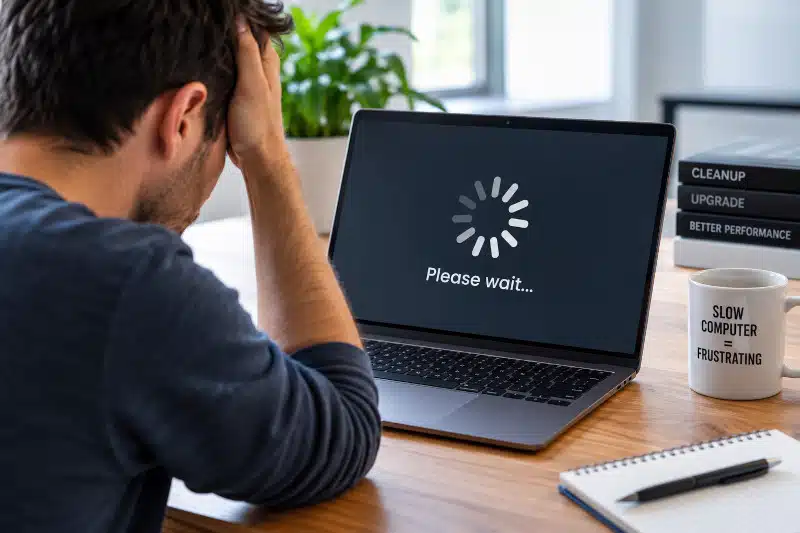
Why is my laptop super slow? If you’ve found yourself asking this question, the answer isn’t always as simple as an aging computer. Slow laptop performance can result from software, storage, memory, overheating, malware, background activity, or hardware that no longer meets your needs.
Sometimes a laptop becomes slow gradually. In other cases, performance changes almost overnight. The timing and type of slowdown can provide useful clues about what’s happening.
Before replacing the laptop or purchasing upgrades, it makes sense to identify the actual cause. A proper diagnosis can determine whether the problem requires software cleanup, hardware service, an upgrade, or another solution.
Why Is My Laptop Super Slow All of a Sudden?
A laptop that suddenly becomes much slower than normal may have a different problem from one that has gradually slowed over several years.
Sudden performance changes can sometimes occur because of:
- Windows background activity
- Recently installed software
- Excessive startup programs
- Malware or unwanted programs
- Storage-drive problems
- Low available storage
- Overheating
- A malfunctioning hardware component
- Applications consuming excessive system resources
Think about when you first noticed the slowdown.
Did the laptop become slow after installing software? Does the problem occur only during certain applications? Did you notice freezing, unusual noises, excessive heat, or other symptoms at the same time?
These details can help narrow down the possible cause.
Why Does a Laptop Gradually Become Slower?
Gradual slowdowns are also common.
Over time, you may install more applications, add background services, fill up the storage drive, and expect the computer to run newer, more demanding software.
Meanwhile, the laptop’s original hardware hasn’t changed.
A computer that performed everyday tasks comfortably several years ago may struggle with today’s workload if it has limited memory, an older processor, or slow storage.
However, age alone doesn’t determine performance.
An older laptop with adequate hardware and an SSD may still handle everyday computing well. Meanwhile, a newer entry-level laptop with limited memory or storage can feel slow much sooner.
That’s why I prefer evaluating the computer’s specifications, condition, and actual workload rather than assuming that an older laptop automatically needs to be replaced.
Too Many Startup Programs Can Slow Down a Laptop
Many applications configure themselves to start automatically with Windows.
One or two startup applications may have little effect. However, numerous programs launching simultaneously can increase boot time and consume memory and processor resources.
You may notice that the laptop:
- Takes a long time to become responsive after signing in.
- Works better several minutes after startup.
- Has numerous applications running in the background.
- Becomes sluggish immediately after Windows loads.
Startup programs aren’t necessarily harmful. Antivirus software, cloud-storage applications, hardware utilities, and other programs may have legitimate reasons to run automatically.
The goal isn’t to disable everything. Instead, unnecessary background software should be distinguished from applications the computer actually needs.
Can Background Programs Make My Laptop Super Slow?
Yes. An application doesn’t need to appear on your screen to use system resources.
Background applications can consume:
- Processor time
- Memory
- Storage activity
- Network bandwidth
Cloud synchronization, software updates, antivirus scans, browser processes, communication applications, and other programs can all contribute to temporary resource usage.
A single background task may not cause a noticeable problem. However, several resource-intensive processes running simultaneously can make a laptop feel sluggish.
Persistent slow performance requires examining the overall system rather than assuming a single background program is responsible.
Does Insufficient RAM Make a Laptop Slow?
RAM provides temporary working memory for Windows and running applications.
When a laptop has enough RAM for its workload, programs can access frequently needed information quickly. When available memory becomes limited, Windows must manage those resources more aggressively.
You may notice problems when:
- Running several applications simultaneously
- Opening many browser tabs
- Editing large photographs or videos
- Gaming
- Using memory-intensive professional software
- Multitasking heavily
Adding RAM can significantly improve some laptops when insufficient memory is the actual bottleneck.
However, a RAM upgrade won’t fix every slow computer.
A laptop with a storage problem, overheating issue, malware infection, or an inadequate processor won’t suddenly become fast simply by adding memory.
Additionally, many newer laptops use memory soldered directly to the motherboard. Therefore, RAM isn’t upgradeable on every model.
Could Your Storage Drive Be Slowing Down Your Laptop?
Storage can have a major effect on how responsive a computer feels.
However, there are several different storage-related problems to consider.
The Storage Drive Is Nearly Full
Windows needs adequate free space for updates, temporary files, applications, and other system operations.
A drive with very little remaining capacity can contribute to performance and maintenance problems.
Large downloads, videos, photographs, games, temporary files, and unused applications can gradually consume available storage.
The Laptop Still Uses a Mechanical Hard Drive
Some older laptops still use traditional mechanical hard disk drives.
A mechanical hard drive contains moving components and generally provides much slower access times than a solid-state drive.
As a result, a laptop with an HDD may take longer to:
- Start Windows
- Open applications
- Load files
- Install updates
- Complete storage-intensive tasks
On a compatible laptop that’s otherwise worth keeping, replacing a mechanical hard drive with an SSD can substantially improve responsiveness.
The Storage Drive May Have a Problem
Severe or unusual slowdown can sometimes indicate a storage problem rather than simply insufficient capacity.
Possible symptoms may include:
- Extremely long boot times
- Applications taking unusually long to open
- Frequent freezing
- Files taking excessive time to load
- Inconsistent system responsiveness
- Windows repeatedly becoming unresponsive
Storage problems deserve attention because your files may also be involved.
If important data isn’t backed up and the computer begins behaving abnormally, protecting that data should take priority over trying random performance fixes.
Why Is My Laptop Slow When I Open Multiple Programs?
If your laptop works reasonably well with one application but becomes extremely slow when multitasking, memory or processor limitations may be contributing to the slowdown.
Every running application requires system resources.
Web browsers can become particularly demanding when many tabs, extensions, web applications, and multimedia content run simultaneously.
A laptop designed primarily for basic web browsing and office work may struggle if you later expect it to handle video editing, modern gaming, virtual machines, or other demanding workloads.
That doesn’t necessarily mean the computer is defective.
Its hardware may simply no longer match the workload.
Can High CPU Usage Make a Laptop Slow?
The processor handles much of the work required by Windows and your applications.
When one or more processes heavily utilize the CPU, other tasks may become less responsive.
High processor usage can occur during:
- Software installation
- Windows updates
- Antivirus scans
- Video encoding
- Gaming
- File compression
- Background maintenance
- Demanding applications
Temporary high CPU usage isn’t automatically a problem.
However, a laptop that remains heavily loaded during otherwise light use may require further investigation.
The important question is what is consuming the processor and why, rather than simply assuming that the CPU itself needs replacement.
Can Windows Updates Temporarily Slow Down a Laptop?
Yes. Windows may perform downloads, installations, indexing, maintenance, and other background operations that temporarily affect performance.
You may notice this particularly after a major update or when a laptop hasn’t been used for an extended period.
In those situations, the slowdown may improve after Windows completes its work.
However, a computer that remains extremely slow long after background activity has finished may have another underlying problem.
Updates shouldn’t become the automatic explanation for persistent poor performance.
Can Malware Make a Laptop Extremely Slow?
Malware and unwanted software can consume system resources and contribute to poor performance.
Depending on the infection, unwanted software may:
- Run continuously in the background
- Launch unwanted browser processes
- Display excessive advertisements
- Change browser behavior
- Consume processor or memory resources
- Generate unwanted network activity
- Install additional unwanted programs
However, a slow laptop doesn’t automatically mean it has a virus.
Hardware limitations, storage issues, too many startup applications, Windows issues, and overheating can all cause similar symptoms.
If suspicious behavior accompanies the slowdown, my Computer Virus Removal Service in Davenport, FL, can help identify and remove malicious or unwanted software.
Why Is My Web Browser So Slow?
Sometimes the laptop itself isn’t the primary problem.
A browser can become sluggish because of:
- Too many open tabs
- Resource-intensive websites
- Excessive extensions
- Unwanted browser add-ons
- High memory usage
- Background browser processes
If the rest of Windows operates normally but one browser performs poorly, the issue may be more localized.
However, if every application is slow, the cause likely extends beyond the browser.
Internet speed can also affect how quickly websites load, but a slow internet connection doesn’t normally explain why local applications or Windows itself respond slowly.
Can Overheating Make a Laptop Run Slowly?
Yes.
Modern processors and graphics hardware can reduce their operating speed when temperatures become excessive. This behavior, often called thermal throttling, helps control heat.
As a result, an overheating laptop may become noticeably slower during demanding workloads.
Cooling problems can involve:
- Restricted airflow
- Dust accumulation
- Blocked ventilation
- Cooling-fan problems
- Thermal-interface issues
- Heavy sustained workloads
- Problems within the cooling system
A warm laptop isn’t automatically overheating. Gaming laptops and other high-performance systems can generate considerable heat during demanding tasks.
However, unusually high temperatures, combined with performance loss, shutdowns, or other symptoms, warrant attention.
My Laptop Overheating Symptoms guide explains the warning signs of excessive heat in your laptop in greater detail.
Does an Old Laptop Automatically Become Slow?
No.
Laptop age matters, but age alone doesn’t determine whether a computer should feel slow.
Consider:
- Processor capabilities
- Amount of RAM
- Storage type
- Available storage capacity
- Software requirements
- Overall hardware condition
- Cooling performance
- What you expect the computer to do
A well-maintained older laptop with an SSD and adequate memory may still perform everyday tasks comfortably.
Meanwhile, a newer laptop with very limited hardware can struggle with demanding workloads.
The better question is whether the laptop’s current hardware can still meet your computing needs.
If you’re deciding whether additional investment makes sense, my article Repair or Replace a Laptop? How to Decide What’s Worth It explains the factors I recommend considering.
Will a RAM or SSD Upgrade Speed Up My Laptop?
Sometimes.
The right hardware upgrade can make a noticeable difference when it addresses an actual performance bottleneck.
RAM Upgrade
Additional RAM can help when the laptop regularly runs short of memory during normal use.
However, more RAM won’t significantly improve performance if memory capacity isn’t the cause of the slowdown.
SSD Upgrade
Replacing a traditional mechanical hard drive with a solid-state drive can substantially improve startup times and general responsiveness on a compatible laptop.
An SSD upgrade can be particularly worthwhile when the rest of an older laptop remains in good condition.
However, replacing an already healthy, adequately performing SSD simply because a computer feels slow may not address the root cause.
Before purchasing parts, determine what the laptop supports and which component is limiting performance.
My Computer Hardware Upgrades in Davenport, FL service can help determine whether a compatible RAM or storage upgrade makes sense.
Why I Don’t Recommend Generic PC Optimization Programs
When a laptop becomes slow, you may encounter programs promising to clean, optimize, boost, or dramatically speed up the computer.
I don’t recommend installing generic optimization utilities simply because a laptop feels sluggish.
Some utilities provide functions Windows already includes. Others may unnecessarily change settings, generate alarming warnings, promote additional software, or fail to address the real performance problem.
Likewise, registry cleaning isn’t a universal solution for a slow computer.
The better approach is to determine why the laptop is slow.
If insufficient RAM is the problem, cleaning the registry won’t add memory.
A failing storage drive won’t be repaired by an optimization utility.
Likewise, deleting temporary files won’t correct a cooling system that’s causing thermal throttling.
Diagnosis should guide the solution.
Not sure what is causing your laptop to run so slowly? Contact PCMechanic Computer Repair in Davenport, FL for professional laptop performance diagnostics and repair.

Should You Reset or Reinstall Windows Because a Laptop Is Slow?
Not automatically.
A clean Windows installation can resolve certain software-related problems, but reinstalling Windows isn’t the appropriate first response to every slow computer.
If hardware failure, insufficient RAM, overheating, or a storage issue causes the slowdown, reinstalling Windows may not solve it.
Before taking such a significant step, determine whether the problem actually points toward Windows.
When operating system corruption or severe software issues are the cause, my Windows Installation & Reinstallation Service may be appropriate.
When Does a Super Slow Laptop Need Professional Diagnosis?
If you’re still asking, “Why is my laptop super slow?”, a professional diagnosis makes sense when the slowdown is severe, persistent, or hard to explain.
For example, further diagnosis may help when:
- Windows takes an unusually long time to start.
- Applications repeatedly freeze.
- The laptop suddenly becomes much slower.
- Performance continues getting worse.
- The computer becomes excessively hot.
- You suspect malware.
- The storage drive may have a problem.
- You’re considering a RAM or SSD upgrade.
- You’re unsure whether repair or replacement makes more sense.
Several problems can produce similar symptoms.
That’s why replacing parts or reinstalling Windows without identifying the cause can waste time and money.
Laptop Performance Diagnostics in Davenport, FL
If your laptop has become frustratingly slow, I can evaluate the computer and determine what may be limiting its performance.
The solution depends on what I find.
A slow laptop may need software cleanup, malware removal, Windows repair, additional memory, an SSD upgrade, cooling-system attention, or another hardware repair.
In other cases, the computer’s hardware may simply no longer provide the performance required for the owner’s workload.
I don’t assume that every slow laptop needs an upgrade or that every older laptop needs to be replaced.
Instead, I evaluate the computer’s condition and performance before recommending the appropriate next step.
For other hardware, Windows, cooling, or performance problems, learn more about my Laptop Repair services in Davenport, FL.
Frequently Asked Questions About a Super Slow Laptop
Why Is My Laptop Super Slow All of a Sudden?
A sudden slowdown can result from background activity, recently installed software, malware, overheating, storage issues, or other hardware or software issues. The timing and other symptoms can help identify the cause.
Why Is My Laptop Slow Even Though It’s New?
A newer laptop can still feel slow if it has entry-level hardware, limited RAM, slow storage, too many startup programs, or demanding applications. Newer doesn’t automatically mean faster for every workload.
Will Adding More RAM Make My Laptop Faster?
It can when insufficient memory causes the slowdown. However, additional RAM won’t fix problems caused by overheating, malware, storage failure, or processor limitations. Some laptops also have soldered memory that cannot be upgraded.
Will an SSD Make My Laptop Faster?
Replacing a mechanical hard drive with an SSD can significantly improve responsiveness on a compatible laptop. However, replacing an existing healthy SSD won’t necessarily resolve a slowdown caused by another component or a software issue.
Can a Full Storage Drive Slow Down My Laptop?
Very low available storage can cause performance and maintenance issues because Windows and applications need free space to operate. However, storage capacity is only one possible cause of slow performance.
Can Overheating Slow Down My Laptop?
Yes. Excessive temperatures can cause the CPU or GPU to reduce performance to control heat. Cooling-system problems should be diagnosed rather than assuming that every warm laptop is overheating.
Can a Virus Make My Laptop Slow?
Yes. Malware and unwanted software can consume processor, memory, storage, and network resources. However, slow performance alone doesn’t prove that the laptop has malware.
Why Is My Laptop Slow After Startup but Faster Later?
Startup applications, Windows maintenance, updates, synchronization software, and other background processes can consume resources shortly after you sign in. If the slowdown persists, another issue may be responsible.
Is My Laptop Too Old to Be Worth Upgrading?
Not necessarily. Age is only one consideration. Specifications, physical condition, upgradeability, repair cost, current performance, and what you need the laptop to do all matter.
Should I Buy a New Laptop if Mine Is Very Slow?
Not before determining why it’s slow. A repairable software problem or worthwhile hardware upgrade may restore acceptable performance. However, replacement may make more sense when the laptop has inadequate hardware, multiple problems, or no longer meets your needs.
Get Help With a Super Slow Laptop in Davenport, FL
If you’re still wondering, “Why is my laptop super slow?”, don’t assume that you automatically need a new computer.
Software problems, insufficient memory, storage issues, malware, overheating, background activity, or aging hardware can all affect performance.
I can diagnose the laptop, explain what’s causing the slowdown, and recommend the appropriate solution based on the computer’s condition and your needs.
Contact PCMechanic Computer Repair in Davenport, FL today for professional laptop performance diagnostics and repair.