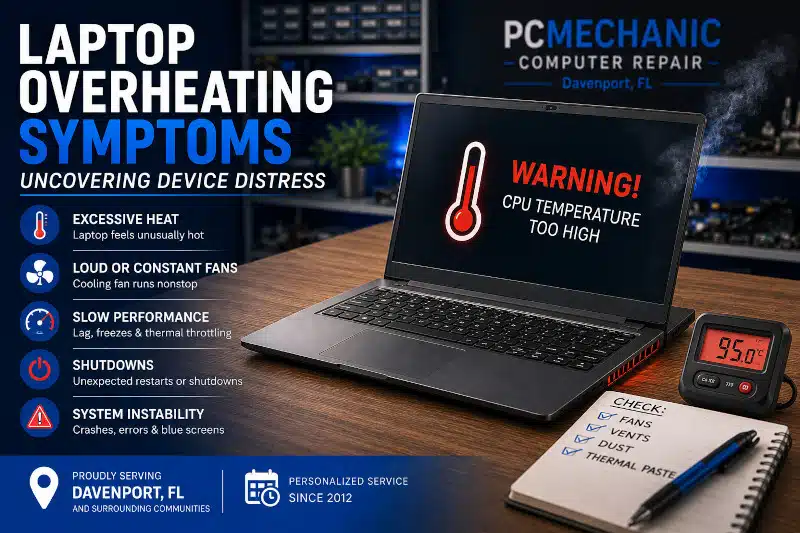
Laptop overheating symptoms can include excessive heat, loud or constantly running fans, slow performance, freezing, thermal throttling, and unexpected shutdowns. Although laptops normally generate heat during use, persistently high temperatures can indicate restricted airflow, dust buildup, cooling fan problems, or other issues affecting the cooling system.
Recognizing these warning signs early can help prevent performance problems and unnecessary stress on internal components. However, not every warm laptop is overheating. Understanding the difference between normal operating heat and a genuine cooling problem can help determine when your laptop needs attention.
Is It Normal for a Laptop to Get Hot?
Some heat is completely normal.
Modern laptops contain processors, graphics hardware, storage devices, and other components inside a compact enclosure. These components generate heat whenever the computer operates.
Additionally, demanding activities can increase temperatures considerably. Gaming, video editing, installing Windows updates, running several applications, or performing processor-intensive tasks can make a laptop noticeably warmer.
The cooling system responds by increasing fan speed and moving hot air away from internal components.
Therefore, a warm laptop or an occasionally louder cooling fan doesn’t necessarily indicate a problem.
The concern begins when excessive heat occurs regularly during light use or appears alongside other laptop overheating symptoms, such as severe performance loss, freezing, persistent fan noise, or unexpected shutdowns.
Common Laptop Overheating Symptoms
An overheating laptop may display several warning signs. Some symptoms are obvious, while others can easily be mistaken for Windows, software, or hardware problems.
Laptop Feels Excessively Hot
One of the easiest symptoms to notice is excessive heat from the laptop case.
The bottom panel, keyboard area, or regions near the exhaust vents may become warm during normal operation. However, unusually high temperatures that persist during basic tasks can indicate that the cooling system isn’t removing heat effectively.
Where you feel the heat can vary depending on the laptop’s internal design.
For example, the processor and cooling assembly may sit toward the rear of one model but closer to the center or side of another.
Therefore, the location of the heat alone doesn’t identify the failed component.
Cooling Fan Runs Constantly or Becomes Very Loud
Laptop cooling fans automatically adjust their speed based on temperature.
When the processor or graphics hardware produces more heat, the fan may spin faster. This behavior is normal during periods of high workload.
However, a fan that runs at high speed almost continuously during ordinary use may indicate a cooling problem.
Possible causes include restricted airflow, dust accumulation, high background CPU usage, deteriorating thermal performance, or a cooling fan not operating properly.
A fan that suddenly becomes unusually noisy may also have a mechanical problem.
Grinding, rattling, scraping, or inconsistent fan sounds warrant attention, as the fan may no longer be spinning properly.
How to Diagnose an Overheating Laptop
Diagnosing an overheating laptop involves looking at several symptoms rather than relying on a single temperature reading. A laptop can become warm during demanding workloads without necessarily having a cooling problem.
However, persistent excessive heat, combined with thermal throttling, unexpected shutdowns, unusually weak airflow, abnormal fan noise, or severe performance loss, may indicate that the cooling system needs attention.
The cause can vary. Restricted airflow, dust buildup, a malfunctioning cooling fan, excessive workload, or another cooling-system problem can produce similar symptoms. Therefore, identifying the underlying cause is more useful than assuming that one particular component has failed.
If overheating persists during normal use despite adequate ventilation, a professional diagnosis can determine whether the problem involves airflow, the cooling fan, another cooling-system component, software activity, or a different hardware issue.
You can also learn practical ways to reduce unnecessary heat buildup in my article, “Preventing Laptop Overheating: What You Need to Know.”
Slow Performance Can Be a Laptop Overheating Symptom
Excessive heat can affect performance.
Modern processors include thermal protection mechanisms designed to prevent temperatures from rising beyond safe operating limits. When temperatures become too high, the system can reduce processor performance.
This process is commonly called thermal throttling.
You may notice applications becoming sluggish, games losing performance, or the computer responding more slowly after it has been running for some time.
The laptop may initially perform normally, then become progressively slower as temperatures rise.
However, slow performance doesn’t automatically mean that a laptop is overheating. Insufficient RAM, storage issues, too many startup programs, Windows issues, malware, and aging hardware can cause similar symptoms.
Temperature and cooling-system behavior therefore need to be considered alongside overall system performance.
Unexpected Shutdowns or Restarts
Unexpected shutdowns are among the more serious laptop overheating symptoms.
A computer may shut itself down when temperatures become excessive. This protective behavior helps reduce the risk of components operating beyond their thermal limits.
However, overheating isn’t the only cause of unexpected shutdowns.
Battery problems, power issues, Windows errors, failing hardware, and other conditions can produce similar symptoms.
If a laptop repeatedly shuts down after becoming unusually hot, particularly during demanding tasks, the cooling system should be evaluated.
Repeatedly restarting the laptop without identifying the cause doesn’t address the underlying problem.
Freezing and System Instability
An overheating laptop may also freeze, become unresponsive, or behave unpredictably.
For example, programs may stop responding, the mouse pointer may freeze, or Windows may become unstable during intensive workloads.
Again, these symptoms aren’t exclusive to overheating.
Memory problems, storage issues, software corruption, Windows issues, and other hardware failures can also cause freezing.
Therefore, temperature-related symptoms should be diagnosed rather than assuming excessive heat is automatically responsible.
What Causes Laptop Overheating?
Several conditions can prevent a laptop from managing heat effectively.
Dust and Restricted Airflow
Laptop cooling systems rely on airflow.
The cooling fan pulls air through the computer and moves heat out through the chassis vents. Over time, dust can accumulate around fan blades, heatsinks, and exhaust openings.
As airflow becomes restricted, the cooling system may need to work harder to maintain normal temperatures.
Heavy dust accumulation can eventually substantially reduce cooling efficiency.
Blocked Air Vents
Where you use a laptop can affect cooling.
Soft surfaces such as beds, blankets, couches, and cushions may obstruct ventilation openings located on the bottom or sides of the computer.
Without adequate airflow, internal temperatures can rise quickly.
Using the laptop on a firm, flat surface generally allows its ventilation system to operate as intended.
Cooling Fan Problems
A cooling fan can wear out or develop mechanical problems.
A failing fan may spin too slowly, operate intermittently, make unusual noises, or stop completely.
Because many laptops depend heavily on active cooling, a malfunctioning fan can quickly cause temperatures to increase.
Some laptops use more than one cooling fan, particularly gaming and high-performance models.
Aging Thermal Compound
Thermal compound helps transfer heat from processors to the cooling assembly.
Over time, its effectiveness can deteriorate. In some situations, poor heat transfer can lead to higher operating temperatures even when the cooling fan is still working.
However, thermal compound shouldn’t automatically be blamed whenever a laptop becomes hot. The complete cooling system should be evaluated before deciding what repair is necessary.
Heavy CPU or GPU Workloads
High temperatures don’t always indicate defective hardware.
Gaming, video rendering, large software installations, intensive multitasking, and other demanding workloads can significantly increase CPU and GPU activity.
Consequently, the cooling fans may become louder, and the laptop may feel warmer.
The more important question is whether the cooling system can operate reliably without severe throttling, instability, or shutdowns.
Software and Background Activity
Software can indirectly contribute to excessive heat.
A program that continually consumes CPU resources can keep the CPU under load even when you aren’t actively using demanding applications.
Windows updates, background applications, malware, and software problems can sometimes create this behavior.
Therefore, an overheating diagnosis shouldn’t focus exclusively on physical cooling components.
What Is Thermal Throttling?
Thermal throttling is a protective mechanism built into modern processors and graphics hardware.
When a component reaches a temperature threshold, the computer may automatically reduce its clock speed and performance. Producing less performance also reduces heat output.
Therefore, thermal throttling itself isn’t necessarily a hardware failure.
It is part of the computer’s thermal protection system.
However, frequent or severe throttling during ordinary use can indicate that the cooling system isn’t dissipating heat effectively.
A laptop that performs normally when first turned on but becomes noticeably slower as it gets hotter may warrant further investigation.
Can Laptop Overheating Cause Damage?
Modern laptops include several safeguards designed to prevent overheating. Nevertheless, persistent overheating shouldn’t be ignored.
Continually high temperatures can contribute to:
- Reduced performance
- Thermal throttling
- Unexpected shutdowns
- System instability
- Increased cooling-fan wear
- Additional thermal stress on internal components
Excessive heat can also make the laptop unpleasant or uncomfortable to use.
The goal isn’t to assume that every warm laptop is being damaged. Instead, persistent overheating symptoms should be investigated before the cooling problem becomes more severe.
What Should You Do When Your Laptop Keeps Overheating?
Start by considering how and where the laptop is being used.
Make sure ventilation openings aren’t obstructed and place the computer on a firm surface that allows normal airflow.
Also, consider what the laptop does when temperatures rise.
If the computer only becomes warm during demanding workloads and returns to normal afterward, the behavior may be expected.
However, excessive heat during basic activities such as web browsing, email, or ordinary office applications deserves closer attention.
Persistent fan noise, repeated shutdowns, severe performance loss, or unusual mechanical fan sounds can indicate a problem that requires diagnosis.
Avoid repeatedly forcing an overheating laptop through demanding workloads when it is already showing signs of instability.
Laptop running unusually hot, slowing down, or shutting off unexpectedly? Contact PCMechanic Computer Repair in Davenport, FL for professional laptop overheating diagnosis and repair.

When Laptop Overheating Needs Professional Diagnosis
Laptop overheating symptoms can have several possible causes, and some problems can’t be identified simply by touching the laptop case.
The cause may include dust accumulation, restricted internal airflow, a failing cooling fan, poor heat transfer, excessive processor activity, or another hardware or software issue.
Professional diagnosis can help distinguish between normal operating temperatures and a cooling system that isn’t functioning properly.
If your laptop continues to overheat despite proper ventilation, my Laptop Repair in Davenport, FL service includes overheating diagnosis and many other common laptop hardware and software problems.
I can evaluate the symptoms and determine whether cleaning, cooling fan service, software troubleshooting, or another repair is appropriate.
Why Choose PCMechanic for Laptop Overheating Problems in Davenport, FL?
I have provided computer repair services in Davenport, Florida, since 2012.
When a customer brings me an overheating laptop, my goal is to identify what is actually causing the excessive heat rather than assume that a particular component needs replacement.
Because several problems can produce similar symptoms, proper diagnosis is important.
PCMechanic Computer Repair is a home-based repair business. Customers arrange to drop off and pick up their computers directly with me.
If replacement parts aren’t required, many laptop problems can be addressed promptly. However, repairs involving model-specific cooling fans or other components depend on parts availability.
I can explain what I find and discuss the available repair options before proceeding.
Frequently Asked Questions About Laptop Overheating Symptoms
What are the most common laptop overheating symptoms?
Common symptoms include excessive case temperatures, constantly running or unusually loud cooling fans, thermal throttling, reduced performance, freezing, and unexpected shutdowns. However, several other hardware and software problems can cause similar symptoms.
Is it normal for my laptop to feel hot?
Some warmth is normal, particularly during gaming or other demanding workloads. Persistent excessive heat during light use, especially when accompanied by loud fans, slow performance, or shutdowns, may indicate a cooling problem.
Why does my laptop fan run constantly?
The fan may be responding to high processor temperatures, heavy background activity, restricted airflow, dust accumulation, or another cooling problem. A constantly running fan doesn’t necessarily mean the fan itself has failed.
Can overheating make my laptop slow?
Yes. When temperatures become too high, the processor or graphics hardware may reduce performance through thermal throttling. However, many non-temperature-related issues can also slow a laptop down.
Why does my laptop shut down when it gets hot?
A laptop may shut itself down when temperatures reach excessive levels. This can be a thermal protection measure. However, battery, power, Windows, and other hardware problems can also cause unexpected shutdowns.
Can a bad laptop fan cause overheating?
Yes. A fan that spins too slowly, works intermittently, or stops completely can prevent the cooling system from moving enough air through the laptop.
Can laptop overheating damage internal components?
Persistent excessive heat can increase thermal stress, contribute to instability, increase fan wear, and affect performance. Modern laptops also use thermal throttling and shutdown protections to help manage excessive temperatures.
When should I have an overheating laptop checked?
Consider professional diagnosis when excessive heat occurs during ordinary use, the cooling fan becomes unusually noisy, performance deteriorates significantly, or the laptop freezes or shuts down repeatedly.
Get Help With Laptop Overheating in Davenport, FL
If your laptop becomes excessively hot, runs its cooling fan constantly, slows down, freezes, or unexpectedly shuts down, the cooling system may need attention.
Rather than guessing which component is responsible, proper diagnosis can determine whether the problem involves airflow, the cooling fan, thermal performance, software activity, or another issue.
Contact PCMechanic Computer Repair in Davenport, FL for professional laptop overheating diagnosis and repair.