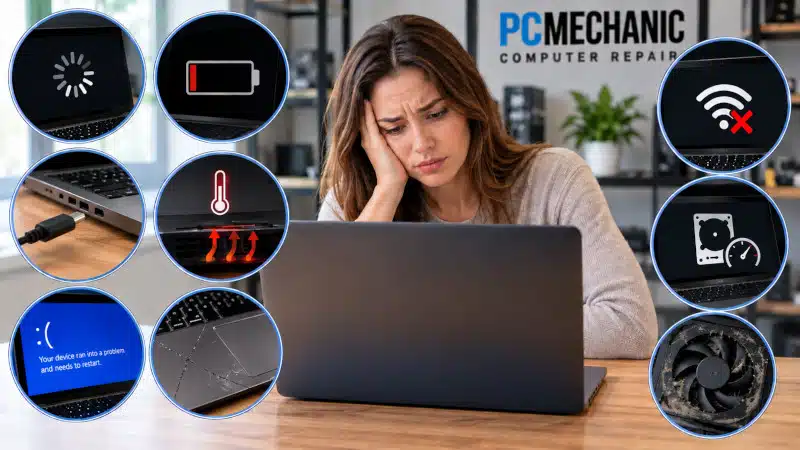
 Common laptop problems can range from slow performance and charging issues to overheating, battery failure, keyboard problems, and unexpected Windows crashes. Although some symptoms have simple explanations, others can result from multiple hardware or software issues.
For example, a laptop that won’t charge doesn’t automatically need a new battery. Likewise, an overheating laptop doesn’t necessarily have a failed cooling fan.
Therefore, identifying the actual cause matters before replacing parts or making major changes to Windows.
This guide covers some of the most common laptop problems, what may cause them, and when professional diagnosis or repair makes sense.
Why Common Laptop Problems Aren’t Always Easy to Diagnose
Many laptop problems share similar symptoms.
A computer that runs slowly could have insufficient memory, storage problems, malware, excessive background activity, or overheating. Meanwhile, a laptop that unexpectedly shuts down could have a battery, cooling, Windows, or hardware problem.
Replacing parts based only on symptoms can become expensive if the first replacement doesn’t solve the problem.
Instead, consider what the laptop is doing, when the problem occurs, and whether any other symptoms appear at the same time.
1. Slow Performance Is One of the Most Common Laptop Problems
Slow performance is one of the most common laptop problems.
A laptop may slow down gradually over time or experience a sudden drop in performance.
Possible causes include:
- Too many startup applications
- Excessive background processes
- Insufficient RAM
- Nearly full storage
- A slow mechanical hard drive
- Storage-drive problems
- Malware or unwanted software
- Windows problems
- Overheating and thermal throttling
- Hardware that no longer meets your workload
The type of slowdown can provide useful clues.
For example, a laptop that becomes slow only when several applications are open may have different limitations from one that takes several minutes to start Windows.
Likewise, a sudden and severe performance change deserves more attention than a computer that has gradually become slower as software demands have increased.
My article, Why Is My Laptop Super Slow? Common Causes and Solutions, explains these performance problems in greater detail.
2. Common Laptop Problems That Prevent a Laptop From Turning On
A laptop that won’t power on can have several possible causes.
The problem may involve:
- Power adapter
- Battery
- Charging port
- Internal power circuitry
- Motherboard
- Another hardware component
It’s also important to distinguish between a laptop that has no power and one that powers on but doesn’t successfully start Windows.
For example, lights and fan activity may indicate that the laptop is receiving power even though nothing appears on the screen.
Meanwhile, a computer that reaches a manufacturer logo but doesn’t load Windows has a different type of problem.
These distinctions help determine whether diagnosis should focus on power, hardware, startup, or Windows.
3. Charging Issues Are Common Laptop Problems
Charging problems don’t automatically mean the battery has failed.
The charger, battery, charging port, USB-C cable, power circuitry, or a battery-management setting may be responsible.
Possible symptoms include:
- Battery percentage doesn’t increase.
- Charging starts and stops.
- The laptop charges only when the cable is at a particular angle.
- Battery drains while the charger is connected.
- Laptop works on AC power but shuts down when unplugged.
- Laptop doesn’t recognize the charger.
- Battery stops charging at a specific percentage.
USB-C charging adds another consideration, as not every USB-C charger and cable can provide the power required by every laptop.
My article, My Laptop Is Not Charging: Common Causes and What to Do, explains how issues with the battery, charger, charging port, and USB-C can produce similar symptoms.
4. Laptop Battery Drains Too Quickly
Rechargeable laptop batteries gradually lose capacity as they accumulate use and charge cycles.
As battery capacity decreases, the laptop may not run as long between charges.
However, short runtime doesn’t always mean the battery needs immediate replacement.
Screen brightness, demanding applications, background activity, power settings, and workload can also affect how quickly a battery discharges.
Signs of significant battery deterioration may include:
- Very short runtime
- Rapid percentage drops
- Unexpected shutdowns on battery power
- Battery-health warnings
- Difficulty maintaining a charge
- Laptop operating reliably only while plugged in
Battery age provides useful context, but condition and actual performance matter more than an arbitrary number of years.
My article, Laptop Battery Care: How to Extend Battery Life and Lifespan, explains the factors that influence battery longevity.
If diagnostics confirm that the battery has deteriorated and a compatible replacement is available, my Laptop Battery Replacement Service in Davenport, FL may be appropriate.
5. Laptop Battery Is Swollen
A swollen lithium-ion battery requires more immediate attention than ordinary battery deterioration.
Battery swelling can place pressure on the laptop’s internal components and enclosure.
Warning signs may include:
- Bottom cover bulging
- Laptop case separating
- Touchpad lifting
- Touchpad becoming difficult to click
- Keyboard or palm rest rising
- Laptop no longer sitting flat
- Visible battery expansion
If you suspect battery swelling, stop using and charging the laptop until the battery can be evaluated.
Don’t puncture, squeeze, bend, or attempt to flatten an expanded battery. Also, don’t force separated case panels back into position.
My Swollen Laptop Battery: Warning Signs, Causes, and What to Do article explains battery swelling and the appropriate next steps in greater detail.
6. Overheating Is One of the Most Common Laptop Problems
Laptops naturally generate heat during operation. Gaming, video editing, software installation, and other demanding workloads can increase temperatures considerably.
Therefore, a warm laptop isn’t automatically overheating.
A cooling problem becomes more concerning when excessive heat appears alongside symptoms such as:
- Significant performance loss
- Thermal throttling
- Unexpected shutdowns
- Extremely high temperatures
- Weak airflow
- Abnormal fan behavior
- Persistent overheating during ordinary use
Possible causes include restricted airflow, dust accumulation, cooling fan problems, thermal interface issues, or heavy, sustained workloads.
Modern processors can reduce their operating speed when temperatures become excessive. Consequently, overheating can sometimes make a laptop noticeably slower.
My article, Laptop Overheating Symptoms, explains the warning signs and potential causes in greater detail.
7. Cooling Fan Problems Are Common Laptop Problems
Laptop cooling fans contain moving components, so mechanical wear can eventually occur.
However, a loud fan doesn’t automatically mean it has failed.
A healthy cooling fan may become noticeably louder when the CPU or GPU generates more heat. That’s especially common during gaming and other demanding tasks.
More concerning symptoms include:
- Grinding
- Rattling
- Clicking
- Scraping
- Fan repeatedly starting and stopping
- Weak airflow
- Fan not spinning when expected
- Sudden changes in normal fan behavior
Dust can also restrict airflow without necessarily damaging the fan itself.
Therefore, diagnosis should determine whether the cooling system needs cleaning, fan replacement, or another repair.
My article, Why Do Laptop Fans Go Bad? Exploring the Common Causes and Solutions explains why cooling fans fail and how to recognize potential fan problems.
Not sure what’s causing your laptop problem? Contact PCMechanic Computer Repair in Davenport, FL for professional laptop diagnostics and repair.

8. Laptop Keyboard Isn’t Working Properly
Laptop keyboard problems can range from a single malfunctioning key to an entire keyboard that stops responding.
Possible symptoms include:
- Keys don’t respond.
- Keys produce incorrect characters.
- Multiple keys stop working.
- Keys stick or repeat.
- Keyboard works intermittently.
- Entire keyboard stops responding.
The cause can involve physical damage, liquid exposure, keyboard failure, connection problems, or software issues.
Individual key replacement also isn’t always practical.
Depending on the laptop design, the keyboard may be a separate component or integrated into the palm-rest assembly.
If the keyboard itself has failed, my Laptop Keyboard Replacement in Davenport, FL service can determine whether replacement is practical for the specific model.
9. Windows Crashes or Displays a Blue Screen
A Windows blue screen indicates that the operating system encountered a serious error and couldn’t continue running normally.
One isolated crash doesn’t necessarily mean the laptop has a major hardware failure.
However, repeated blue screens deserve investigation.
Possible causes can include:
- Driver problems
- Windows corruption
- Memory errors
- Storage problems
- Hardware instability
- Software conflicts
- Other system faults
The information displayed during a blue screen can sometimes help identify the direction of the diagnosis. Still, similar error messages can have more than one underlying cause.
Therefore, repeatedly reinstalling drivers or resetting Windows without determining the cause of the crashes may not solve the problem.
10. Laptop Freezes or Becomes Unresponsive
A laptop that repeatedly freezes can be particularly frustrating because the problem may occur at random.
Freezing can result from:
- Software problems
- Insufficient memory
- Storage issues
- Excessive resource usage
- Windows corruption
- Overheating
- Hardware instability
- Malware or unwanted software
Pay attention to when the freezing occurs.
For example, does it happen immediately after startup, while using a particular application, during gaming, or seemingly at random?
A computer that becomes unresponsive during storage-intensive tasks may require a different diagnostic approach than one that freezes only under heavy CPU or GPU workloads.
Recurring freezes shouldn’t simply be dismissed as an unavoidable part of using an older laptop.
11. Laptop Has Wi-Fi Connection Problems
Wi-Fi problems can originate from the laptop, wireless router, internet connection, software configuration, or surrounding network environment.
Common symptoms include:
- Laptop won’t connect to Wi-Fi.
- Connection repeatedly drops.
- Wireless network doesn’t appear.
- Internet performance is unusually slow.
- Other devices work while the laptop doesn’t.
- Laptop connects but reports no internet access.
First, determine whether the problem affects only the laptop or all devices on the same network.
If multiple devices lose connectivity simultaneously, the problem may involve the router or internet service rather than the laptop itself.
However, if other devices work normally and only one laptop has problems, that laptop warrants closer investigation.
12. Laptop Takes Forever to Start
Slow startup can result from several different conditions.
Possible causes include:
- Excessive startup applications
- Windows background activity
- Limited RAM
- Slow mechanical storage
- Nearly full storage
- Storage-drive problems
- Windows issues
- Malware or unwanted software
An older laptop that still uses a mechanical hard drive may naturally take considerably longer to start than a comparable system equipped with an SSD.
However, a dramatic change in startup time can indicate something more than ordinary hardware limitations.
For example, if Windows previously started normally but suddenly takes several minutes, further diagnosis may be appropriate.
The important distinction is whether the computer has always been relatively slow or has recently become much slower than normal.
Should You Repair, Upgrade, or Replace the Laptop?
Not every laptop problem requires the same solution.
Sometimes repair makes sense. In other situations, a hardware upgrade can extend the useful life of the computer.
Eventually, replacement may become the more practical choice.
Factors worth considering include:
- Age of the laptop
- Processor and hardware capabilities
- Amount of RAM
- Storage type
- Upgradeability
- Physical condition
- Battery condition
- Cost of required repairs
- Availability of replacement parts
- Your current computing needs
Age alone shouldn’t determine the decision.
A well-maintained older laptop with adequate hardware may remain perfectly suitable for everyday use. Meanwhile, an inexpensive newer laptop with limited specifications may not provide the performance someone needs.
My article Repair or Replace a Laptop? How to Decide What’s Worth It explains these considerations in greater detail.
Avoid Replacing Parts Based Only on Symptoms
Many common laptop problems can have several possible causes.
For example, replacing a battery won’t fix a defective charging port.
Likewise, installing additional RAM won’t correct a failing storage drive. Replacing a cooling fan also won’t necessarily solve overheating caused by a blocked heatsink or another cooling problem.
This is why diagnosis matters.
The goal should be to identify the underlying problem before purchasing replacement parts or making major changes to the computer.
That approach can reduce unnecessary repairs and help determine whether fixing the laptop makes financial sense.
When Do Common Laptop Problems Need Professional Diagnosis?
Some basic observations can help narrow down a laptop problem. However, professional diagnosis makes sense when the cause remains unclear, the symptoms are severe, or hardware failure may be involved.
Consider professional diagnosis when:
- The laptop won’t power on.
- Charging is intermittent or unreliable.
- Windows repeatedly crashes.
- The computer frequently freezes.
- The laptop becomes excessively hot.
- A cooling fan makes mechanical noises.
- Battery swelling is suspected.
- The keyboard has physically failed.
- Performance suddenly becomes extremely slow.
- Important data may be at risk.
- You’re unsure which component actually needs repair.
Replacing parts through trial and error can quickly become expensive.
A diagnosis provides a better basis for deciding what the laptop needs.
Laptop Repair for Common Laptop Problems in Davenport, FL
At PCMechanic Computer Repair, I diagnose and repair common laptop problems for customers in Davenport, Florida, and the surrounding areas.
Depending on the problem, laptop services may include:
- Hardware diagnostics
- Windows troubleshooting and repair
- Virus and malware removal
- Laptop battery replacement
- Compatible charging-port replacement
- Laptop keyboard replacement
- Cooling-system service
- Fan replacement
- RAM upgrades where supported
- Storage upgrades
- Data backup and file transfer
I don’t automatically recommend replacing parts simply because a particular symptom appears.
Instead, I evaluate the laptop, identify the likely cause, and explain the practical repair options.
For more information about the laptop problems I service, visit my Laptop Repair services in Davenport, FL page.
Frequently Asked Questions About Common Laptop Problems
What Are the Most Common Laptop Problems?
Common laptop problems include slow performance, charging issues, battery degradation, overheating, fan problems, keyboard failure, Windows crashes, freezing, storage issues, and Wi-Fi connectivity problems.
Why Is My Laptop Suddenly Running Very Slowly?
A sudden slowdown may be caused by background activity, software changes, malware, overheating, storage issues, or other hardware or Windows issues. Additional symptoms can help narrow down the cause.
Why Won’t My Laptop Charge?
The charger, battery, charging port, USB-C cable, internal power circuitry, or a battery-management feature may be responsible. A charging problem doesn’t automatically mean the battery needs replacement.
Why Does My Laptop Keep Overheating?
Restricted airflow, dust accumulation, cooling-fan problems, thermal-interface issues, or demanding workloads can contribute to excessive heat. A warm laptop isn’t necessarily overheating, so other symptoms matter.
Why Is My Laptop Fan Making a Grinding Noise?
Grinding or rattling may indicate mechanical wear or bearing problems inside the cooling fan. However, diagnosis should confirm whether the fan itself has failed before replacement.
Why Does My Laptop Keep Freezing?
Software problems, insufficient memory, storage issues, overheating, Windows corruption, malware, or hardware instability can cause repeated freezing.
Why Does My Laptop Keep Showing a Blue Screen?
Windows can display a blue screen due to driver issues, operating system corruption, memory problems, storage faults, software conflicts, or other hardware instability. Repeated crashes warrant further investigation.
Should I Repair or Replace an Older Laptop?
It depends on the laptop’s specifications, condition, repair cost, upgradeability, and whether it still meets your needs. Age alone doesn’t determine whether replacement makes sense.
Can Adding RAM Fix a Slow Laptop?
Additional RAM can improve performance when insufficient memory is the bottleneck. However, it won’t fix problems caused by storage failure, overheating, malware, Windows corruption, or an inadequate processor.
Can Replacing a Hard Drive With an SSD Improve Laptop Performance?
Yes. Replacing a mechanical hard drive with a compatible SSD can significantly improve startup times and general responsiveness. However, an SSD upgrade won’t solve unrelated hardware or software problems.
Get Help With Common Laptop Problems in Davenport, FL
Common laptop problems don’t always have obvious causes. Slow performance, charging issues, overheating, crashes, battery problems, and hardware failures can produce overlapping symptoms.
Instead of replacing parts through trial and error, identifying the actual problem can help determine the most practical solution.
I can diagnose your laptop, explain what I find, and recommend repair or upgrade options based on the computer’s condition and your needs.
Contact PCMechanic Computer Repair in Davenport, FL today for professional laptop diagnostics and repair.