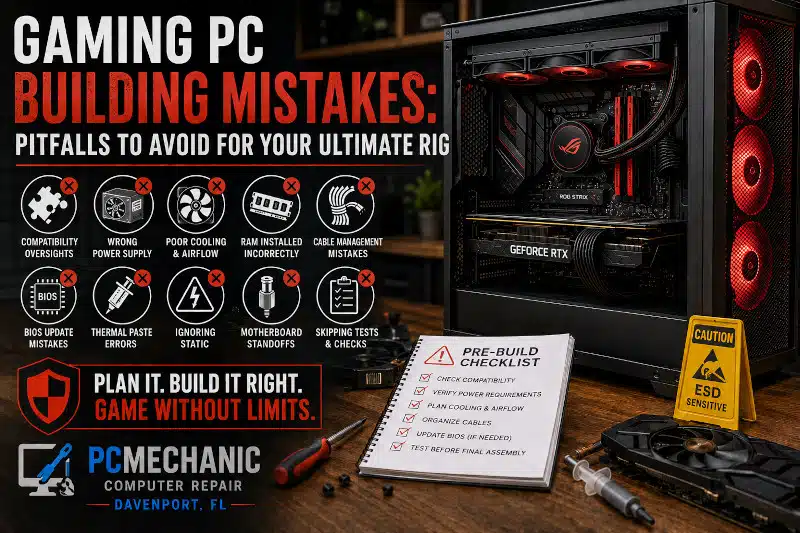
Gaming PC building mistakes can turn an exciting custom build into an expensive troubleshooting project. Choosing incompatible components, overlooking power requirements, installing hardware incorrectly, or rushing through configuration can prevent a new computer from starting or operating reliably.
Building a Gaming PC also involves more than installing expensive components into a case. The processor, motherboard, memory, graphics card, storage, power supply, cooling system, and enclosure must work together properly.
Fortunately, careful planning can prevent many common problems before assembly begins.
If you’re preparing for your first custom build, understanding these mistakes can help you avoid unnecessary expenses, damaged hardware, and frustrating startup problems.
Buying Gaming PC Components Before Checking Compatibility
One of the most expensive Gaming PC building mistakes happens before the computer is ever assembled: purchasing parts without verifying compatibility.
A powerful processor, graphics card, and motherboard aren’t useful if they cannot work together.
For example, processor compatibility depends on the motherboard socket, chipset, and sometimes the installed BIOS version. Likewise, the motherboard determines which memory generation and configurations the system supports.
Compatibility considerations can also include:
- CPU socket and motherboard chipset
- DDR4 or DDR5 memory support
- Memory capacity and supported configurations
- Graphics card dimensions
- CPU cooler compatibility
- Power supply requirements
- Case dimensions
- Storage interfaces
- Available expansion slots
- Fan and radiator mounting locations
Therefore, component selection should be treated as a complete system rather than a collection of individual parts.
If you’re still planning your system, my “Parts Needed to Build a Gaming PC” guide outlines the major components required for a complete build.
Choosing the Wrong Power Supply
The power supply shouldn’t be selected solely based on the wattage printed on the box.
A Gaming PC needs a quality PSU with sufficient capacity for the installed CPU, graphics card, storage devices, cooling hardware, and other components. Additionally, it needs the appropriate hardware connections.
An undersized or unsuitable power supply can contribute to instability, particularly when the CPU and GPU are under heavy load.
However, an efficiency rating alone doesn’t determine PSU quality. Efficiency, build quality, voltage regulation, electrical protections, connector availability, and suitability for the intended hardware are separate considerations.
It’s also unnecessary to purchase an excessively oversized PSU simply because more wattage sounds better.
Instead, choose a unit appropriate for the hardware while allowing reasonable capacity for the system’s expected load and potential upgrades.
Reusing the Wrong Modular Power Supply Cables
This mistake deserves special attention because the cables from modular power supplies may look interchangeable when they aren’t.
Never assume modular PSU cables from one power supply are compatible with another.
The connectors on the component side may appear identical, while the wiring at the PSU end can differ between manufacturers, models, and product families.
As a result, using an incompatible modular cable can damage connected hardware.
When installing or replacing a modular power supply, use the cables specifically approved for that PSU model. If cable compatibility is uncertain, verify it with the power supply manufacturer rather than relying on appearance.
Keeping the original PSU cables organized and labeled can also prevent confusion during future upgrades.
Not Checking Component and Case Clearance
Electrical compatibility isn’t the only consideration when planning a Gaming PC.
Everything also needs to physically fit.
Modern graphics cards can be long and thick enough to interfere with front-mounted radiators, drive cages, expansion cards, or other hardware. Meanwhile, large air coolers can exceed the maximum CPU cooler height supported by a case.
Before purchasing components, check:
- Graphics card length
- Graphics card thickness
- CPU cooler height
- Radiator dimensions
- Radiator and fan clearance
- RAM clearance around large CPU coolers
- Power supply dimensions
- Motherboard form factor
- Case component limitations
A component being technically compatible doesn’t guarantee that it will physically fit into the chosen enclosure.
Understanding Gaming PC Case Compatibility and Motherboard Form Factor can help prevent size and mounting issues before parts are purchased.
Overlooking Cooling and Case Airflow
High-performance hardware can generate substantial heat during gaming.
However, installing more fans isn’t automatically the solution. The case needs a sensible airflow path that allows cooler air to enter and warmer air to leave.
Restricted front panels, insufficient ventilation, incorrectly positioned fans, or an enclosure that’s too cramped for the installed hardware can make temperature management more difficult.
Cooling requirements also vary according to the processor, graphics card, case design, workload, and selected CPU cooler.
Therefore, cooling should be considered when choosing components, rather than after the computer has been assembled.
My Gaming PC Maintenance guide explains how dust, cooling hardware, airflow, and temperature changes can affect a Gaming PC under sustained loads.
If the enclosure itself is limiting cooling or component space, the Benefits of Upgrading a PC Case explains when moving the hardware into a better case may make sense.
Installing Case Fans in the Wrong Direction
Case fans need to work together rather than fight one another.
Most Gaming PCs use a combination of intake and exhaust fans. Intake fans bring cooler outside air into the enclosure, while exhaust fans remove heated air.
A fan installed in the wrong direction can disrupt the intended airflow path.
Additionally, installing several fans without considering their purpose can produce an inefficient cooling configuration.
Before mounting a fan, identify the direction in which it moves air. Many manufacturers place directional markings on the fan frame.
The ideal configuration depends on the case and hardware, so there isn’t one universal fan arrangement for every Gaming PC.
Installing RAM in the Wrong Configuration
Memory installation looks simple, but incorrect placement can cause problems.
Motherboards with multiple memory slots usually specify which DIMM slots to use for configurations with one, two, or more memory modules.
For example, installing two memory sticks into arbitrary slots may prevent the system from operating in the intended memory-channel configuration.
Don’t assume the correct slots based solely on their physical position or color.
Instead, follow the motherboard manufacturer’s recommended DIMM population configuration.
Also verify that each memory module is fully seated. Partially installed RAM can cause a new computer to fail to start up or exhibit memory-related instability.
Mishandling Thermal Paste and CPU Cooler Installation
Thermal paste helps transfer heat between the processor and the CPU cooler.
Too little, excessive application, contamination, or poor contact with the cooler can interfere with proper heat transfer. However, thermal paste isn’t a substitute for correct cooler installation.
The cooler must sit properly against the processor with appropriate mounting pressure.
Some coolers arrive with thermal compound pre-applied. In that situation, additional paste generally isn’t necessary unless the manufacturer’s instructions specify otherwise.
Another surprisingly easy mistake is leaving protective material on the cooler’s contact surface before installation.
For best results, follow the CPU cooler manufacturer’s installation and thermal compound instructions.
Installing Motherboard Standoffs Incorrectly
Motherboard standoffs separate the motherboard from the metal computer case.
They must align with the motherboard’s mounting holes.
A misplaced standoff beneath an area without a mounting hole can contact the underside of the motherboard where it shouldn’t. Consequently, incorrect installation can potentially cause an electrical short or physical damage.
Before installing the motherboard, verify that the case’s standoff positions match its form factor and mounting-hole layout.
Also avoid overtightening motherboard screws. They should secure the board without unnecessary force.
Forgetting Important Power Connections
A newly assembled Gaming PC that won’t start doesn’t necessarily contain a defective component.
Sometimes a required power connection was simply overlooked.
A typical build may require connections for:
- Main motherboard power
- CPU/EPS power
- Graphics card power
- SATA-powered devices
- Fan or RGB controllers
- Liquid-cooling pumps or controllers
Graphics card power connections deserve particular attention because requirements vary considerably between GPUs.
Likewise, CPU power connectors near the top of the motherboard can be easy to overlook once the motherboard is installed in the case.
Before assuming a component has failed, verify the required power connections and follow the hardware manufacturer’s installation instructions.
Rushing Through Cable Management
Cable management improves appearance, but aesthetics aren’t its only purpose.
Well-routed cables can keep wires away from fans, simplify future upgrades, and make components easier to access.
However, there’s no need to force every cable into an extremely tight route merely to make the back of the case look perfect.
Avoid excessive tension on connectors and cables. In addition, make sure cables aren’t pinched between panels or routed against sharp edges.
The goal should be a clean, accessible installation that doesn’t interfere with fans, panels, or components.
Ignoring Static Electricity While Handling Components
Computer components can be damaged by electrostatic discharge.
Therefore, use sensible precautions while handling processors, memory, motherboards, graphics cards, and storage devices.
Work in an appropriate environment and avoid unnecessary contact with exposed electrical contacts or circuitry. Handle expansion cards and memory by their edges whenever practical.
You also shouldn’t place sensitive components on inappropriate surfaces while assembling the system.
The goal is straightforward: minimize unnecessary static buildup and handle expensive hardware carefully.
Updating the BIOS Without a Reason
BIOS updates can be important, but a new version doesn’t automatically mean every computer needs it immediately.
Firmware updates may address processor support, memory compatibility, security vulnerabilities, system stability, or specific hardware problems.
However, updating firmware unnecessarily introduces an avoidable risk if the update process is interrupted or the wrong firmware is used.
Before performing an update, determine why the system needs it and review the motherboard manufacturer’s release information.
My article, BIOS Update for Gaming PCs, explains when a BIOS update may be appropriate and why the process requires care.
Skipping Initial Testing and System Checks
Finishing the physical assembly doesn’t mean the Gaming PC is ready to use.
The system still needs to start correctly, recognize its hardware, and operate reliably.
Initial checks should confirm that important components are detected and that temperatures remain within an appropriate range.
After Windows and the necessary drivers are installed, system testing can also reveal memory instability, cooling problems, incorrect settings, or other issues that aren’t immediately obvious during the first startup.
For this reason, I don’t consider a Gaming PC build complete simply because Windows loads.
A properly configured system should be tested before it’s put into regular gaming use.
Want to avoid costly mistakes when assembling your new gaming PC? Contact PCMechanic Computer Repair in Davenport, FL, for professional assembly, compatibility verification, configuration, and system testing.

Assuming Every Startup Problem Means a Bad Component
One of the most common Gaming PC-building mistakes is immediately assuming something is defective when the computer doesn’t start properly.
A no-POST condition can result from something as simple as:
- RAM that isn’t fully seated
- A missed CPU power connection
- Incorrect display connection
- Graphics card seating
- Unsupported BIOS version
- Improper front-panel connections
- A loose power cable
Replacing components without first identifying the cause can quickly become expensive.
If the new system doesn’t behave as expected, work through the problem methodically rather than randomly replacing hardware.
Avoid Gaming PC Building Mistakes With Professional Assembly
Building your own computer can be rewarding. However, not everyone wants to risk troubleshooting assembly problems with expensive components.
You can still choose and purchase the hardware yourself without having to assemble everything.
At PCMechanic Computer Repair, customers can bring me their Gaming PC components for professional assembly. I can also help identify compatibility problems before components are purchased.
My Gaming PC Build Services in Davenport, FL, can include component-selection assistance, compatibility verification, hardware assembly, cable management, BIOS configuration, Windows and driver installation, and system stability testing.
This approach gives you control over the components while helping you avoid many common Gaming PC-building mistakes.
Frequently Asked Questions About Gaming PC Building Mistakes
What is the most common mistake when building a Gaming PC?
Component incompatibility is one of the most common and potentially expensive problems. CPU sockets, motherboard chipsets, RAM generations, case dimensions, cooler compatibility, and power requirements should be checked before purchasing parts.
Can using the wrong modular PSU cable damage a Gaming PC?
Yes. Modular power supply cables aren’t universally interchangeable. Even cables with similar-looking connectors may use different wiring arrangements. Use only cables confirmed as compatible with the specific PSU.
Can installing RAM in the wrong slots affect performance?
Yes. Motherboards generally specify particular slots for different memory configurations. Incorrect placement may prevent the intended memory-channel configuration or cause startup problems. Follow the motherboard manual.
Can too much thermal paste damage a CPU?
The more important concerns are achieving proper heat transfer and installing the cooler correctly. Excessive thermal paste is unnecessary and can create a mess. Follow the cooler or thermal compound manufacturer’s recommendations.
Do all Gaming PCs need liquid cooling?
No. Quality air cooling is appropriate for many Gaming PCs. The correct cooling solution depends on the processor, power consumption, workload, case compatibility, airflow, and desired noise levels.
Should I update the BIOS immediately after building a Gaming PC?
Not automatically. A BIOS update may be appropriate for CPU compatibility, memory support, stability fixes, security patches, or other specific needs. Review the motherboard manufacturer’s information before updating.
Why won’t my newly built Gaming PC turn on?
Several issues can prevent a new system from starting, including incomplete power connections, improperly seated RAM or GPU, front-panel wiring issues, incompatible hardware, or lack of firmware support. Diagnosis should begin with the configuration rather than assuming a component has failed.
Can I buy my own Gaming PC parts and have PCMechanic assemble them?
Yes. You can purchase your own components and bring them to PCMechanic Computer Repair for professional assembly. I can also help verify component compatibility before you make your purchases.
Avoid Costly Gaming PC Building Mistakes
Careful planning and assembly can prevent many Gaming PC problems, but building a computer still involves numerous considerations for compatibility, installation, cooling, configuration, and testing.
If you’ve selected your components but would rather have your Gaming PC professionally assembled and tested, I can help.
Contact PCMechanic Computer Repair in Davenport, FL, for component compatibility assistance and professional Gaming PC Build Services.